

The best coffee table shape for a sectional depends on the open space inside the seating arrangement, not the size of the sofa itself. Round and square tables often suit a balanced seating pocket, while oval and rectangular tables can serve a longer sofa run. Before you start shortlisting living room coffee tables and matching end tables, measure the sectional’s actual seat edges, chaise, and walking routes. The overall width of the sofa alone cannot tell you what will fit.
A sectional creates more than one relationship to the table. Someone sitting along the main sofa needs a surface within comfortable reach, while someone on the chaise needs space to move their legs and stand up. The right shape balances those needs without filling every inch of the opening. Begin with the way people sit and move, then consider the style.
Table of Contents
Identify the shape of the seating pocket
Measure the pocket, not the outline
Look at the area between the fronts of the occupied seats, rather than the outside outline of the sectional. A long sofa with a short chaise can leave a narrow rectangular pocket. A sectional with similarly sized arms can create a more balanced opening. These spaces may need different tables even when the sofas have similar total widths.
L-shaped sectionals: check the chaise route
For an L-shaped sectional, check whether the chaise projects into the main route through the room. A round or oval table may reduce a protruding corner along that route. A rectangular table can work well when the opening is long enough to accommodate it without crowding the chaise end.
U-shaped sectionals: check reach from every seat
For a U-shaped sectional, consider access from the open side and reach from all occupied seats. A square or round table may sit comfortably in a broad central opening. A long narrow table might serve two sides well but leave another seat far from the surface. Test the positions people use most often before optimizing for an occasional guest.
Compare the main coffee table shapes
Shape | Where it can work well | What to test before choosing |
Round | A compact or balanced seating pocket | Reach from the farthest seat and room to pass the chaise |
Oval | A longer opening with a busy route | Usable surface near both ends and clearance at its widest point |
Rectangle | A long main sofa run | Corners near the chaise and access to storage |
Square | A broad opening with seating on several sides | Whether its depth crowds the open entrance |
Adjustable footprint | A room with changing uses | Both positions, moving parts, and storage access |
These are planning patterns, rather than fixed rules. A small rectangle may circulate better than an oversized circle, and a broad oval can consume more space than expected. Compare actual dimensions and base positions instead of assuming that one shape automatically solves a layout problem.
Measure the gap before choosing the length
Measure from the front edge of the seat or chaise to the proposed table edge. As an editorial design starting point, many rooms can begin testing a reach gap around 14–18 inches. Adjust that mock-up for the household, seat depth, and ease of standing. This is a styling heuristic, not an accessibility standard or an operating clearance for reclining furniture.
Next, mark the route people use to enter the seating area. The gap for reaching a cup and the path for walking through the room serve different purposes. A table that is easy to reach can still block the main route. Keep the route outside the seating pocket where possible, rather than expecting everyone to squeeze between the table and sofa.
Measure table height too. A very low surface may suit the appearance of a low sectional but require an uncomfortable reach. A high table can dominate a low seating group. Make a temporary surface at the proposed height and try setting down a mug while seated normally, without perching on the cushion edge.
Use an oval table when the room needs length and softer ends
An oval can provide a longer surface while reducing the projection of sharp rectangular corners at its ends. It can be useful beside a long sofa run where the chaise limits the entrance to the seating pocket. Check its widest section carefully: rounded ends do not make the whole footprint narrow.
Say your sectional has a long main run and a short chaise, and the household wants somewhere to keep remotes, throws, and board games. The Velar 47–67-inch extendable coffee table with a sintered stone top and storage is built for that kind of room. It is listed with an oval shape, four drawers, and an adjustable length. Measure both its retracted and extended positions against the sectional, and include drawer-opening space rather than the closed outline alone.
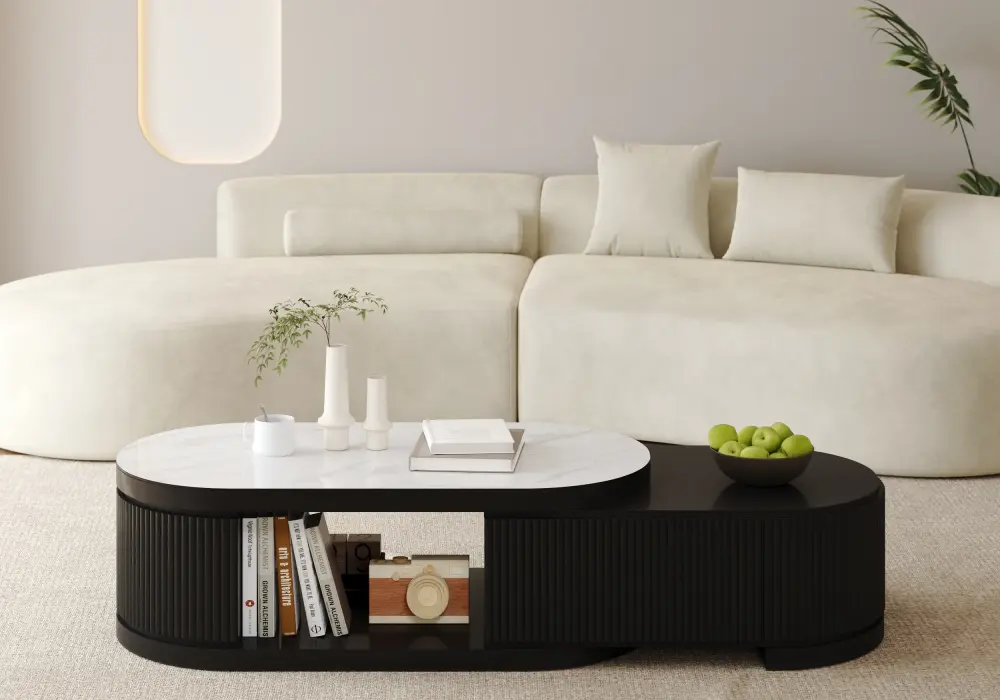
An extended surface may help when guests occupy more seats, but it can also reduce the opening beside the chaise. Decide where people will enter before extending it. If using the larger position means moving another essential piece every time, a fixed smaller table may be more convenient for the room.
Choose a rectangle when several seats share a long edge
A rectangular table follows the main sofa run and offers a continuous surface for several people. Its depth matters as much as its length because the chaise creates a second boundary on one side.
Start with the numbers on the 33–55-inch extendable walnut coffee table with storage. Its official listing gives a 24-inch depth and a 13-inch height, with an adjustable footprint. The depth leaves room to sit a laptop and a drink side by side, so it suits a sectional that mostly hosts snacks, games, or reading. The low height fits some sectional styles, while households that prefer a taller surface for everyday reach should compare it with their seat height first.
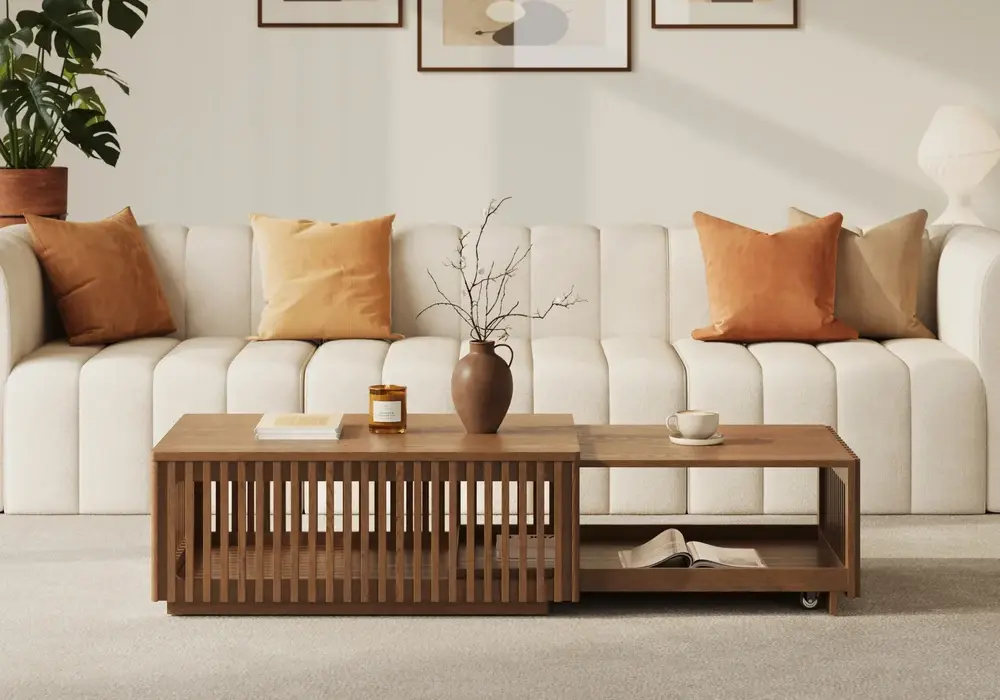
Check where the base sits beneath the top. A solid base can occupy foot space even when the tabletop seems to fit. Open storage also needs a usable approach if you want to reach books or baskets. A table should remain convenient in the position you will use most days, rather than only in a staged arrangement.
Try a compact rounded table when circulation comes first
A compact rounded table leaves more flexibility near a chaise or narrow entrance, and it can soften the sectional’s strong right angles. The tradeoff is reach: people at the ends of a long sofa may need a side table rather than stretching toward the center.
If your living room is small, or the chaise sits close to the doorway, this is the shape to test first. The 28-inch walnut round coffee table with a travertine top offers a compact curved profile. Although its marketed shape is round, the listed footprint is approximately 28 by 25 inches, so plan around the measured outline rather than assuming a perfect circle. Its stone top and walnut-veneer base can introduce material contrast to an upholstered seating group.
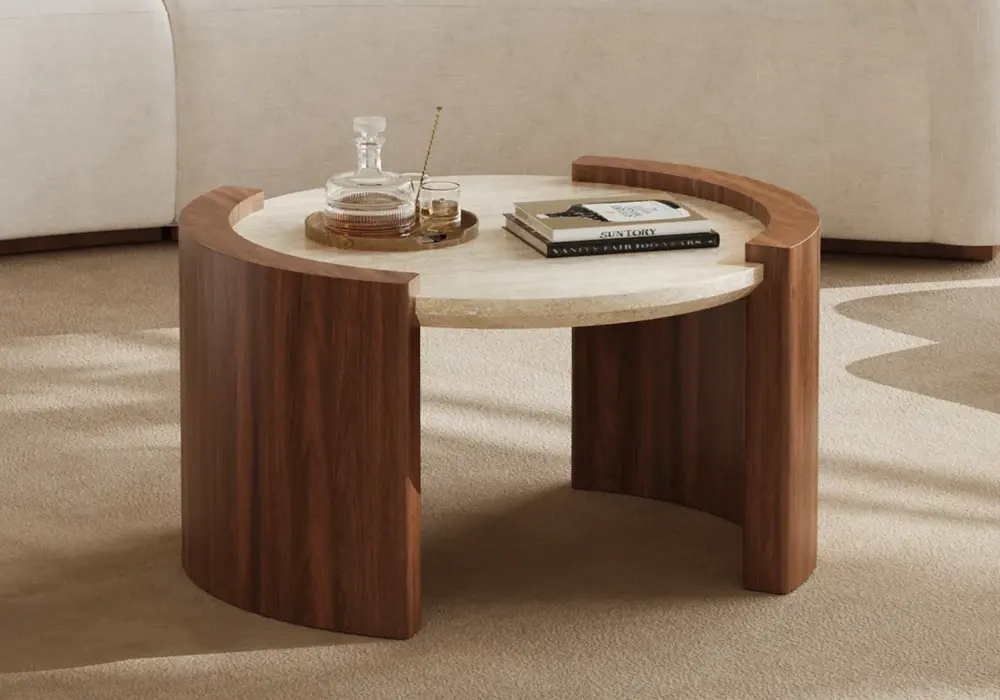
A rounded edge changes the shape of a possible collision; It does not make a table childproof or eliminate the need for clear circulation. Consider stability, material, and the household’s habits as well as the outline. If the table leaves one seat underserved, a carefully placed side surface may solve that issue without enlarging the central table.
Mock up the layout in both ordinary and busy use
Use painter’s tape or paper to mark the proposed shape, including its widest points. Sit in the corner seat, the chaise, and each end seat. Stand up, walk to the door, and open any nearby storage. Repeat the test with the number of people who usually share the room.
For a reclining sectional, follow the sofa manufacturer’s full movement envelope. Ordinary coffee table reach guidance cannot replace the space needed for a moving footrest or backrest. For a sleeper sectional, test the bed conversion too. A table that fits beautifully while the sofa is closed may need a realistic storage location when the bed opens.
Frequently Asked Questions
Is a round or rectangular coffee table better for an L-shaped sectional?
Either can work. A round table can help preserve space near a short chaise or busy entrance. A rectangle can serve a longer main sofa run. Compare the pocket’s dimensions and the route into it, then test reach from the occupied seats before choosing.
Can a square coffee table work with a sectional?
Yes, particularly when the opening is broad and balanced or seating surrounds several sides. Watch its depth at the entrance to the seating pocket. A square table that looks proportional from above may still make it awkward to walk past the chaise or rise from the corner seat.
Should the table sit exactly in the center of the sectional?
It should sit where it works for the seats and circulation. The visual center of the entire sofa can differ from the usable center of the seating pocket. Start with comfortable reach from the main occupied seats, then adjust slightly to preserve the entrance and balance the arrangement.
What if one coffee table cannot reach every seat?
Prioritize the seats used most often and consider a side table for a distant position. Increasing the central table until it reaches everyone can create circulation problems. A second surface should have its own stable location and should not block the route or interfere with any reclining mechanism.
How should I plan an extendable coffee table beside a chaise?
Measure both table positions and mark the direction of extension. Include drawer access and the space people need to stand. If the extended position closes the only route into the seating area, use the smaller position or choose a different footprint rather than relying on frequent rearrangement.