

To style a recliner sofa, begin with its full movement space, then add a coordinated rug, reachable side tables, layered lighting, and a few easily moved textiles. Choose power reclining seating as part of the room's furniture plan, allowing the back, footrest, and controls to work freely. The best arrangement looks composed with the seats upright and still feels comfortable when someone reclines.
A recliner sofa often has more visual weight than a slim stationary sofa. That does not mean everything around it needs to be substantial. A lighter table, a clear walkway, and a restrained color palette can make the room feel balanced. The aim is to give the seating a deliberate setting while preserving the features that make it useful.
Start with the activities that happen most often: watching a film, reading, chatting, or sharing the space with guests. Those habits determine where tables and lamps belong more reliably than a symmetrical photograph does.
Table of Contents
Plan the Room With the Seats Open
Measure the sofa upright and obtain its manufacturer's operating-clearance drawing. Mark the actual reclining envelope on the floor with removable tape that is suitable for your flooring. Include any headrest movement and the required space behind the furniture. Do not assume a forward-moving mechanism permits contact with a wall.
Place a box or lightweight placeholder where you expect the coffee table to stand. Check whether the footrest can extend without meeting it, and whether someone can still leave the seating area. Repeat the exercise for every powered seat rather than testing one end and assuming the rest is equivalent.
A walkway should remain a walkway during ordinary use. If an open footrest cuts across the only route to a door, the sofa may need to rotate or move to another wall. Replacing a bulky central table with two small side tables can help, but it cannot fix an unsuitable furniture footprint.
Record the resulting clear zones before choosing accessories. This makes later decisions easier: a basket either stays outside the mechanism's path or it does not. The room no longer depends on someone remembering to move a heavy object every time they want to relax.
Give the Sofa a Simple Color Framework
Choose one main room color, one supporting material, and one smaller accent. A gray chenille sofa could sit with warm white walls, walnut furniture, and muted olive accessories. A white faux-leather seat could work with a pale rug, a black side table, and a textured neutral throw. These are starting schemes, not mandatory combinations.
Repeat each supporting color in a few separate places. For example, a black table base can relate to a picture frame and a lamp detail. The repetition helps the room feel connected without requiring every furniture finish to match exactly.
Consider undertones in daylight and under your evening lamps. A cool gray sofa beside a yellow-beige rug may look different after sunset. Bring samples together where the furniture will actually sit, and compare larger surfaces before buying several small accents to correct an unwanted combination.
Keep the most changeable color in easy-to-replace pieces such as cushion covers and artwork. That gives the room room to evolve while the sofa, rug, and main storage remain useful. Seasonal styling then becomes a small adjustment instead of a complete redesign.
Match the Surrounding Furniture to the Sofa's Character
A broad, cushioned sofa benefits from some visual contrast. Consider a side table with an open base, a slim floor lamp, or a cabinet raised on legs. Those pieces let the eye move through the room and prevent every object from appearing equally heavy.
The Softplume Chenille Power Reclining Sofa with Center Console is a useful starting point for a media-focused arrangement. Its chenille upholstery and integrated center console suit a relaxed setting. Let the console handle the functions it was designed for, then use the surrounding tables for anything else your household needs.
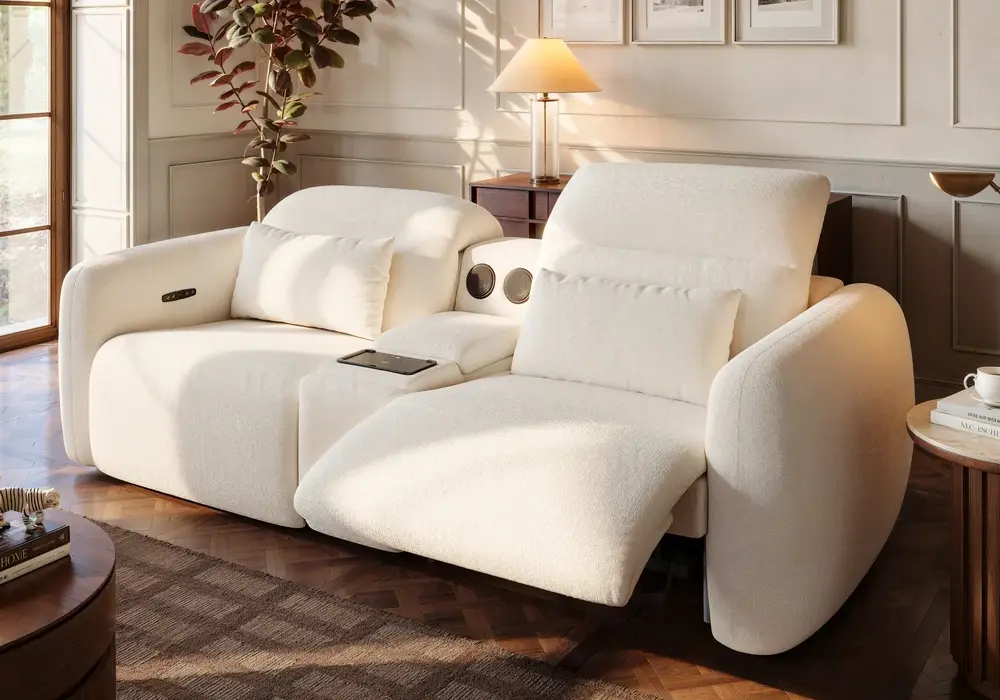
For a hypothetical room around this sofa, pair a warm neutral rug with a modest side table at each accessible end. Add artwork that introduces one restrained color and use a lamp to soften the light near the seating. Keep the floor around the footrests uncluttered rather than filling it with decorative stools.
A large piece does not need a large object on every side. Check the room from the entrance: if the sofa and console already form the focal point, an understated cabinet or simple wall treatment may be enough behind or opposite it.
Choose Tables That Work During Reclining
Position side tables where a seated person can reach them without leaning across a moving arm or standing behind a footrest. The appropriate height depends on the sofa's arm and your reach. Use a temporary surface to test the relationship before committing to a table.
A coffee table can still work, provided it remains outside the full movement envelope and leaves comfortable access. If that puts it too far away for drinks, treat it as a shared central surface and give each regular seat a closer side table. Do not force one central table to perform every job.
Room situation | Styling approach to try | Practical check |
Footrests occupy the center | Small end tables with a lighter central surface | Every seat opens without contact |
One person reads most evenings | Reachable table and focused lamp at that seat | Controls and book remain accessible |
Sofa includes a center console | Keep nearby surfaces visually restrained | Added furniture serves a separate purpose |
Sofa has adjustable headrests | Keep artwork, shelves, and wall lamps behind the seat clear | Raised headrests do not hide or catch décor |
Narrow family room | Fewer floor accessories and a clear exit route | People can leave while seats are open |
Use the table as a set of experiments. The right arrangement is the one that works with your actual furniture, rather than the one that uses the greatest number of coordinated pieces.
Add Cushions and Throws Without Covering the Controls
Begin with fewer cushions than you would put on a deep stationary sofa. One small accent cushion at an end may be enough, especially when the back and headrest already provide substantial padding. Sit down and use the controls to see whether the accessory improves comfort or simply needs to be moved.
Choose texture deliberately. Smooth upholstery can take a nubby woven cushion; chenille may pair well with a smoother fabric or a subtle pattern. Repeating too many plush textures can make the whole seating area look indistinct, while contrast gives individual pieces more definition.
Drape a throw over a stationary section only when the manufacturer's instructions permit it and it stays clear of openings and moving parts. A nearby basket or shelf can be a better place to keep it between uses. Never tuck fabric into the reclining mechanism to make it look neater.
Give displaced cushions a destination. If two people recline every evening, an empty basket or accessible cabinet keeps the room from accumulating a pile on the floor. Styling becomes easier to maintain when each decorative object has somewhere to go during real use.
Let the Upholstery Guide the Styling Direction
Once the layout and color framework are settled, the upholstery decides how the room feels. Leather and woven fabrics reflect light differently, take accessories differently, and suit different daily routines. Comparing two real options makes the choice easier to picture.
A Leather-and-Walnut Direction
The Glidio Curva Genuine Leather Headrest Power Reclining Sofa uses genuine leather on the contact areas, with durable faux leather on the back and sides. That mix suits a room built on contrast: pair the smooth seating surfaces with a nubby throw, a woven basket, or a textured rug. Its walnut-finished oak legs can echo walnut elsewhere in the room, such as a side table or picture frame, which supports the repeated-material idea from the color section.
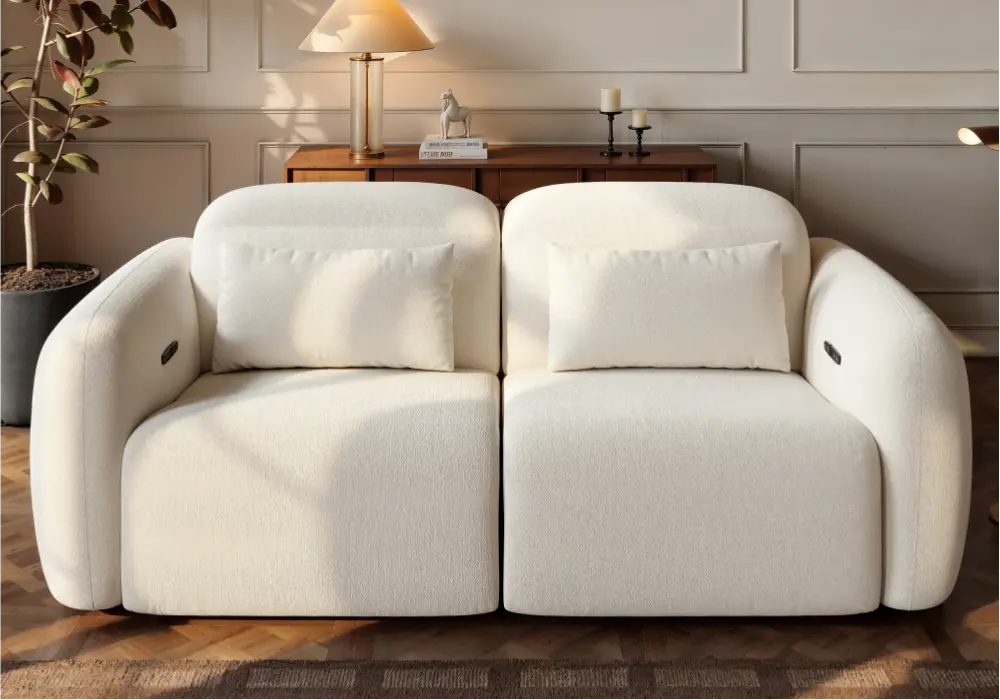
The manually adjustable headrests are a styling detail as well as a comfort feature. When they are raised, the sofa's top line changes, so check whether artwork, a shelf, or a wall lamp behind the seat is partly covered. Test this with the headrests at the positions you actually use, not only in the lowered position.
A Family-Friendly Chenille Direction
For a softer, more everyday setting, the Glidio Chenille Power Reclining Sofa with Adjustable Headrests is made with performance chenille, which is designed to resist everyday spills and wear. That can make a lighter rug or pale cushion covers easier to live with, though you should still follow the care instructions and clean spills promptly.
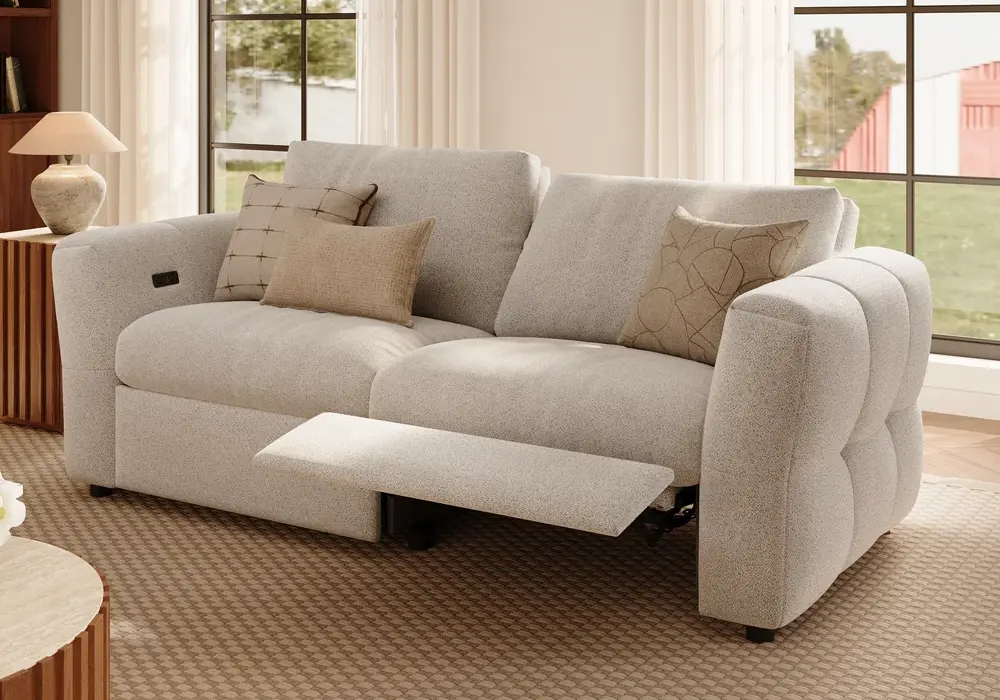
It has five headrest positions, so place a reading lamp where it will not catch the headrest as it moves. The two-seat layout is 86-inch; use that figure when you mark the floor, then add the space needed for the seats and footrests to open. Measuring first keeps the rug, side tables, and walkway in proportion to the actual sofa.
Choose between the two by routine rather than looks alone. If the sofa is used mostly by adults for evening relaxation, the leather-contact option offers a more tailored finish. If it is used daily by a family, the chenille option may fit the way the room is cared for.
Layer Light and Keep the Floor Orderly
Use a combination of general room light and more focused light near reading seats. A floor lamp can frame the sofa's outline, while a table lamp can make an end table feel purposeful. Keep shades and bases outside moving sections and away from likely foot traffic.
Avoid relying on bright overhead lighting alone if the room is mainly used in the evening. Test lamp placement from the seated position: a decorative light that shines directly into your eyes or reflects in the television will quickly become an annoyance.
Plan power access early. Follow the furniture and electrical-product instructions rather than hiding leads beneath rugs or pinching them behind furniture. A tidy room still needs accessible plugs and undamaged cords. Avoid arrangements that require repeated stretching or unplugging just to recline. Some models, including both Glidio sofas above, place USB and USB-C ports on the control panel, which can reduce the need for extra charging leads near the seat. Check where the ports sit before deciding where a side table goes.
For the rug, test how its thickness and edges interact with the sofa's base and movement. A rug can connect the seating visually, but it should not interfere with required support or create a trip edge at the main exit. Keep a clear distinction between the decorative zone and the circulation route.
Edit the Room From Three Useful Viewpoints
Look from the doorway first. Identify the strongest visual feature: the sofa, artwork, window, or television. Remove or relocate anything that competes without adding a useful function. A clear wall above or beside a substantial sofa can be a considered choice.
Next, sit in each regular seat. Check the reach to a drink, the view of the screen or conversation area, and the position of the light. Then open the recliners and repeat the checks. This catches problems that are invisible from a standing photograph.
Finally, try the room during a normal evening. Notice which cushions end up on the floor, which table is never used, and where people hesitate when walking through. Adjust those details before adding more decoration. A room that is easy to reset usually stays attractive longer than one that needs constant staging.
Frequently Asked Questions
How many pillows should go on a recliner sofa?
There is no required number. Start with one or two small accents across the sofa and test every seat. Remove any pillow that blocks controls, crowds the user, or repeatedly needs to be placed on the floor. Built-in cushioning may already provide the visual softness you want.
Can I put a coffee table in front of a reclining sofa?
Yes, when it stays outside the complete movement envelope and preserves access. Measure with the footrests extended and the backs in their normal reclining positions. If the table becomes too distant for practical reach, add side tables rather than reducing the required clearance.
Should I choose leather or chenille for a recliner sofa?
It depends on the look you want and how the sofa will be used. Leather surfaces give a smoother, more tailored appearance, as with the Glidio Curva, which uses genuine leather on the contact areas. Chenille gives a softer, textured look, and a performance version such as the Glidio Chenille Power Reclining Sofa is designed to cope with everyday wear. Check each product's care guidance, then pick the one that suits your household's routine.
Where should I keep throws when the recliners are in use?
Use a basket, shelf, or other accessible storage location outside the movement area. Keep loose textiles clear of hinges, footrests, and cable routes. Choose storage that is easy to reach so the throw does not end up tucked into an opening or left across a walkway.
How can I make a large recliner sofa feel less bulky?
Reduce competing furniture, leave visible floor space, and add a few lighter surrounding forms. A slim lamp, open-base table, restrained palette, and well-sized rug can balance substantial seating. Avoid surrounding it with several equally oversized storage and accent pieces.