

A dining room table's size includes its length, width, and height, but the space it needs also includes chairs and access around them. As a shopping starting point, many six-person rectangular dining tables fall around 60–72 inches long and 36–40 inches wide, with conventional dining height near 28–30 inches. These are flexible design ranges, not a formal standard or a guarantee of seating capacity.
Choose from your everyday diners, chair dimensions, and available room rather than a seat-count label alone. A longer table helps with hosting, while a compact or extendable one keeps everyday meals comfortable. An extending design works best when you picture two layouts: its normal position and the arrangement used when the leaf is open.
Table of Contents
Read length, width, and height as separate decisions
Length determines how seating can be distributed along the sides and ends. Width affects the space between place settings and any shared serving area. Height needs to work with the chosen chairs and the underside of the tabletop. A table can be the right length but still be too wide or have an awkward apron or base for the chairs you own.
Check how the listing labels the dimensions. Some product pages use overall width for the long span and depth for the shorter span. For a convertible table that starts as a round and extends into an oval, the listing usually gives the round diameter as the depth and the extended length as the width, so both layouts share the same depth. A number in the title may also describe maximum extension rather than everyday size, so transfer the full drawing into your room plan.
For an oval table, use the largest length and width to establish the floor envelope, then look at the curved ends and base positions for seating. Rounded corners change movement and appearance, but the space required to sit down or pass behind an occupied chair stays the same.
Size question | Flexible planning reference | What decides the final fit |
Table height | Often around 28–30 inches | Chair seat, arms, and underside clearance |
Six-person rectangular length | Often around 60–72 inches | Chair width, place settings, and base position |
Typical rectangular width | Often around 36–40 inches | Opposing diners and serving needs |
Seating allocation | Begin testing around 24 inches per person | Wider chairs and individual preferences |
Table-edge room clearance | Begin testing around 36–42 inches | Occupied chairs, traffic, and access needs |
Extending design | Draw both lengths | Full open footprint and extra chairs |
These figures are shopping heuristics rather than accessibility or building-code requirements. Allow additional space where the room's circulation or individual access needs call for it.
Start with the room's usable rectangle
Measure between the obstructions that matter: walls, cabinets, radiators, sideboards, and door movement. If a route passes through the dining area, mark it separately. Floor space occupied by another cabinet doesn't count as clearance, even when the room is wide overall.
Subtract a suitable allowance on each side to see which tabletop sizes deserve testing. For a hypothetical room 151 inches long by 111 inches wide, a 79-by-39-inch table leaves 72 inches in each direction, or 36 inches per side if centered. That arithmetic describes an initial layout, and the chairs and routes then refine it.
Add a sideboard projecting into that room and the result changes. A doorway at one end can also make equal clearance on both ends undesirable. Use the real arrangement rather than centering the table automatically. The best position supports sitting, serving, and movement together.
Three dining tables that put these measurements to work
Here are three tables at different sizes, from a compact round-to-oval to a 94-inch extendable oval. Each one gives you a concrete footprint to test against your own room and chairs.
A round-to-oval table for compact dining spaces
The Oakard 39"–55" Extendable Solid Wood Dining Table is made for smaller kitchens and dining nooks. Closed, it is a 39-inch round. Extended, it becomes an oval 55 inches long and 39 inches deep. It stands 30 inches high and seats up to six. The round setting keeps the floor open for everyday meals, and the oval setting welcomes the whole family at weekend dinners.
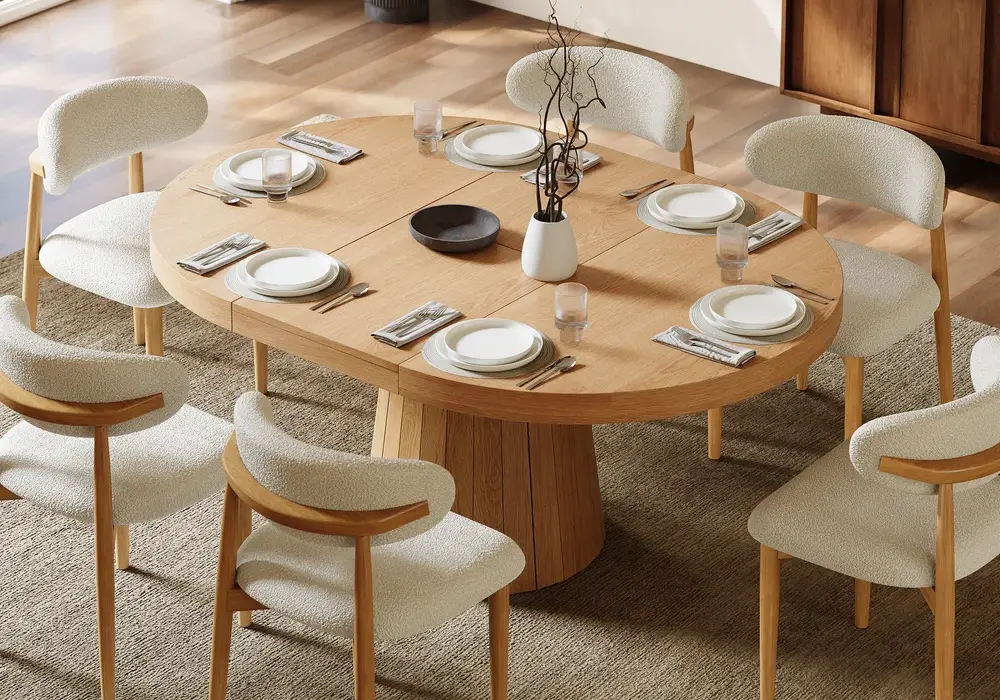
Solid wood construction gives the table lasting stability, and the natural finish brings warmth to Japandi, Scandinavian and modern interiors. The pedestal base leaves the area under the top clear, so chairs slide in and out easily from any side. The softly rounded shape has no sharp corners, which makes it a good fit for families with young children.
A sintered stone table for everyday meals and weekend hosting
The 79-inch White Rectangular Sintered Stone Dining Table pairs a 79-by-39-inch top with a 30-inch height, and it seats six to eight. The sintered stone surface resists scratches, heat and stains and wipes clean in seconds, which suits busy households.
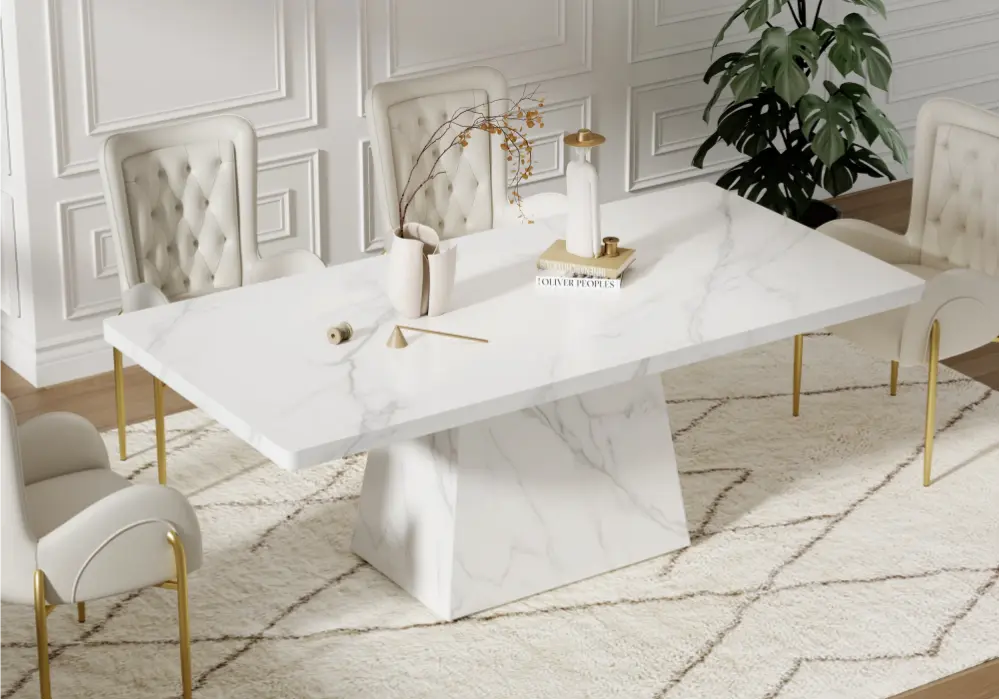
The wide top gives you room for place settings, serving dishes and a centerpiece at the same time. The sculptural pedestal base adds a refined look and leaves extra legroom, so guests can sit and linger comfortably. The indoor/outdoor design lets the table move between a dining room, a patio and a covered outdoor area, and the clean white finish brightens any of them.
An extendable oval that flexes from weeknights to holidays
The Fluve 79–94-inch Oval Extendable Dining Table is 40 inches deep and 30 inches high. Its butterfly-leaf mechanism glides from 79 inches for daily meals to 94 inches for holiday dinners and weekend brunches, seating up to eight.
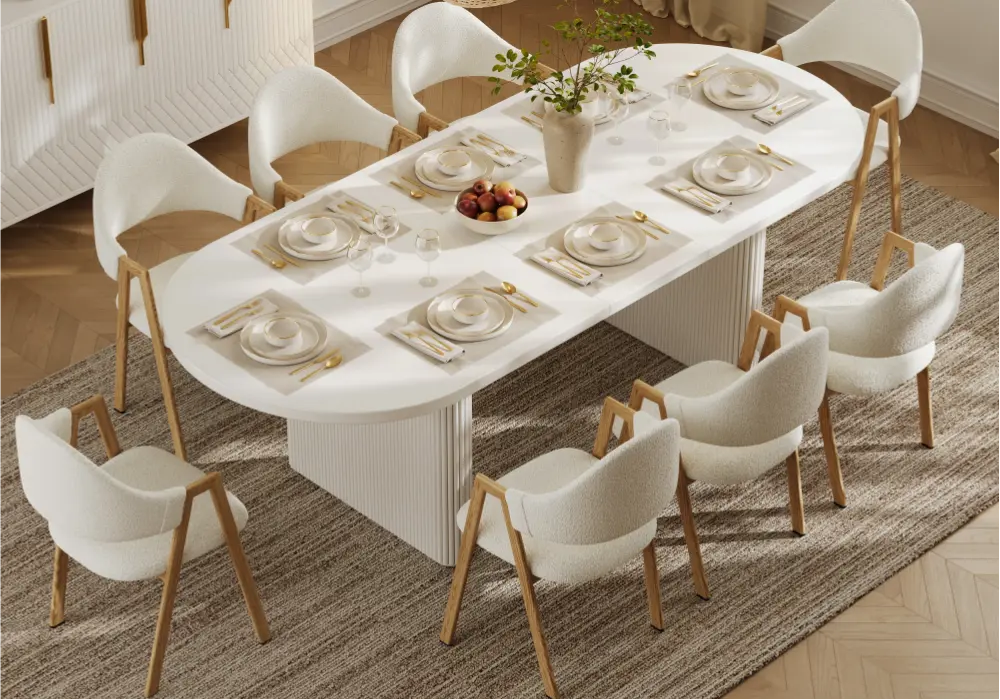
The Japandi-inspired design has clean lines and a natural elegance, and several color options let you match light, dark or neutral interiors. The double pedestal base keeps the table stable and maximizes legroom along both sides. Durable construction and easy maintenance mean it keeps looking good through years of family dinners.
Which one fits your space?
- Small room or 4–6 people: the round-to-oval wood table
- Everyday family dining plus entertaining, indoors or out: the sintered stone table
- Frequent guests and holiday gatherings: the Fluve extendable oval
Count comfortable seats using the chairs you want
Begin with the actual chair width and a realistic place setting. The roughly 24-inch-per-person heuristic helps you sketch positions: measure the perimeter of the tabletop, divide by 24, and you have a starting seat count. For a convertible round-to-oval table, run the calculation twice, once for the round setting and once for the extended oval, since the two layouts seat different numbers of people. Wider chairs and preferred elbow room may call for a little more space, so treat the result as a starting sketch.
Look at the ends separately. Curved tops, pedestal shapes, legs, and overhangs all affect how each end position feels. Pedestal bases, like those on the three tables above, keep the area under the top open, which makes end seats easy to use. Use the table and chair drawings together, then test in person when possible.
Also distinguish everyday comfort from occasional extra seating. A household may be happy with a closer arrangement for a short gathering but prefer more room for daily meals. Choose the table around the experience you want most often, and let an extending design cover the occasions that need more.
Test the occupied layout before ordering
Tape the tabletop envelope on the floor and position the actual chairs, or use temporary markers with their full dimensions. For an extendable table, tape both the closed and open outlines. Pull the chairs out and sit down. Walk past the occupied positions, open nearby cabinets, and check the route from the kitchen with dishes in hand.
Include the other dining-room furniture you intend to keep. A sideboard, bar cart, plant, or open door can create a narrow point that is easy to miss in a simple room-size calculation. Relocate the item causing the conflict before deciding whether the table must be smaller.
Finally, plan delivery and assembly access. Solid wood and sintered stone tops are substantial pieces, so measure doorways, stairs, and the route into the room, and get the package dimensions from the product page for your chosen variant. A successful fit includes getting the furniture into position as well as enjoying it afterward.
Frequently Asked Questions
How long is a dining table for six people?
Around 60–72 inches is a useful initial range for many rectangular options, and compact round-to-oval designs can also seat six when extended. Compare the chosen chairs, tabletop shape, and base. A seat-count label alone doesn't establish how comfortably six particular people will fit.
Is a 79-inch table suitable for eight diners?
A 79-inch table is a comfortable fit for six and can work for eight with the right chairs. Wider chairs, pedestal position, and preferred place-setting space all influence the final count.
How wide should a dining room table be?
Use the room and meal routine to decide. A width around 36–40 inches is a common shopping reference for rectangular tables, and the tables above are 39–40 inches. Check opposing place settings and serving space, then make sure the room still accommodates occupied chairs and movement on both sides.
Does an oval table need less room than a rectangle?
Its curved perimeter changes movement around the ends, but the maximum length and width still establish the initial footprint. Test the actual shape and chairs. A round-to-oval table is a good option for tighter rooms, since it stays compact day to day and expands only when you host.
Should I measure an extendable table while open?
Yes. Plan the retracted and extended arrangements, including extra chairs and the route through the room. Check where the base and leaf sit in each position. When both layouts work in your space, the larger capacity becomes a real benefit for your home.