

What Size Rug Under Dining Room Table?
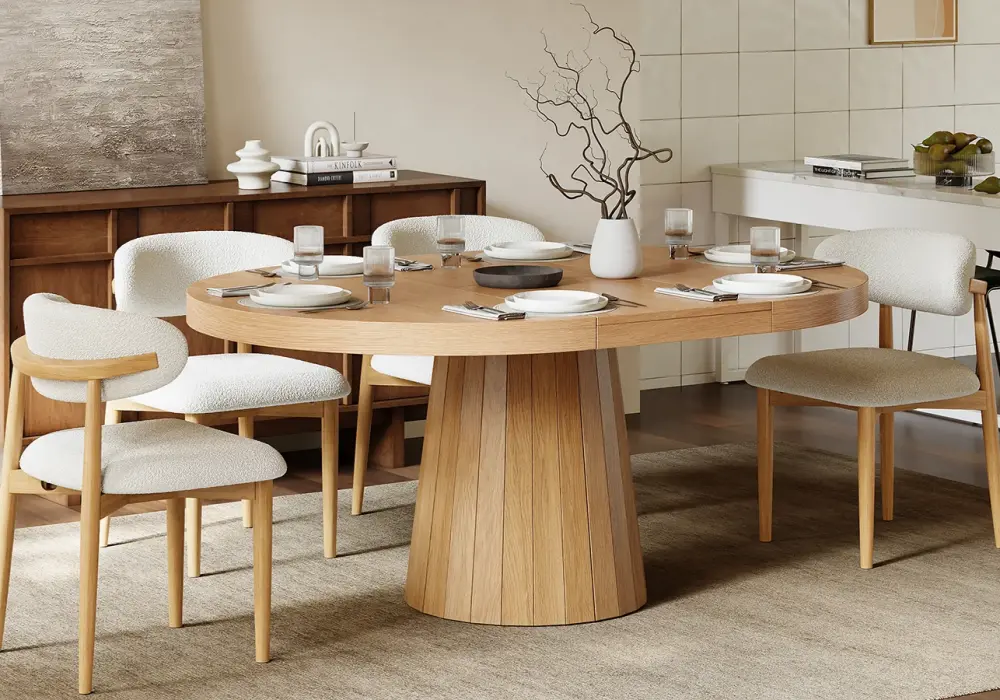
The right dining room rug should do more than fill the space beneath your table. It should give chairs enough room to slide in and out without catching on the rug edge, visually anchor the dining area, and complement the table without making the room feel crowded.
As a general rule, a dining room rug should extend at least 18 inches beyond every side of the dining table, while 24 inches is preferable when space allows. That extra area gives dining chairs enough room to remain on the rug when they are pulled back for sitting.
For example, a 60-inch-long rectangular dining table will generally work better with an 8-foot-long rug than a 6-foot-long rug. The goal is not simply to match the tabletop dimensions; it is to account for the table, chairs, and their full range of movement.
The best rug size therefore depends on four things:
Factor | What to Measure | Why It Matters |
Table | Length and width/diameter | Establishes the starting rug size |
Chairs | Maximum pull-back distance | Determines the necessary overhang |
Room | Available floor space and walkways | Prevents the rug from crowding traffic paths |
Seating style | Chairs, bench, or banquette | Changes how much clearance is needed |
If you're furnishing a dining room from scratch, choose the rug only after determining the final table and seating arrangement. This prevents a common mistake: buying a rug that looks appropriately sized under the table but becomes too small once the chairs are actually in use.
Source Homary
Recommended Rug Overhang and Chair Clearance
The easiest way to calculate a dining room rug size is to start with the table and add enough space for the chairs.
The 18-to-24-Inch Rule
For most dining rooms, plan for 18 inches of rug beyond the table edge as a practical minimum. If the room allows, aim for 24 inches. The larger measurement gives chairs more freedom to move backward while keeping all four chair legs supported by the rug.
The calculation is straightforward:
Rug length = table length + 36–48 inches
Rug width = table width + 36–48 inches
For example, if your rectangular dining table is 60 inches long and 36 inches wide:
- Minimum practical rug: approximately 96" × 72"
- More comfortable target: approximately 108" × 84"
- Common retail size: 8' × 10'
The 8' × 10' option provides considerably more usable clearance than a 6' × 9' rug, particularly when six people are seated around the table.
Why Chair Clearance Matters
A dining chair can move considerably farther from the table than its position when pushed in. If the rug ends immediately behind the rear legs, the chair may catch on the edge every time someone sits down.
That creates three problems:
- Chairs become harder to move.
- The rug edge can shift or curl over time.
- The dining arrangement looks visually disconnected when chairs sit partly on and partly off the rug.
Before purchasing, pull each chair out to its normal sitting position and measure from the table edge to the backmost point of the chair. Add several inches of tolerance rather than designing the rug around a perfectly tight measurement.
For compact dining rooms, 18 inches may be the realistic compromise. In a larger open-plan dining area, 24 inches or more usually creates a more finished and comfortable arrangement.
Rug Sizes by Table Shape and Seating Capacity
The most useful way to shop for a dining room rug is to start with your table dimensions and seating capacity rather than choosing a rug based solely on room size.
The following table provides practical starting points for common U.S. dining configurations.
Dining Table | Typical Seating | Recommended Rug Size | Best Use |
36" round | 2–4 | 6' round | Small dining nook |
48" round | 4–6 | 8' round | Everyday family dining |
60" round | 6–8 | 9' round | Larger dining room |
48" rectangular | 4 | 6' × 9' | Compact dining area |
60" rectangular | 4–6 | 8' × 10' | Most medium dining rooms |
72" rectangular | 6–8 | 8' × 10' | Family dining room |
84–96" rectangular | 8–10 | 9' × 12' | Large dining room |
These are starting points, not rigid rules. A table with unusually deep chairs, wide armchairs, or a thick upholstered seat may require a larger rug.
For a 6-Person Dining Table
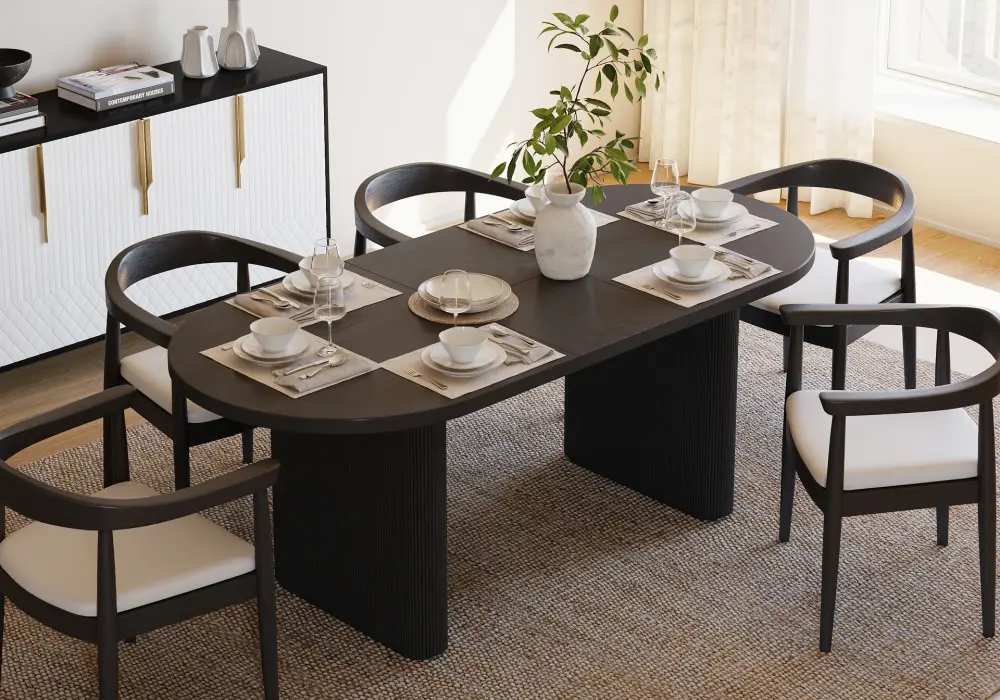
A six-person rectangular dining table is one of the most common configurations in U.S. homes. Tables around 60–72 inches long typically pair well with an 8' × 10' rug.
If the table is closer to 72 inches long and the dining chairs require substantial pull-back space, a 9' × 12' rug can create a more generous arrangement.
Source Homary
For Round Tables
Round tables should generally be paired with round rugs when you want a cohesive, symmetrical appearance. The rug should extend far enough beyond the table's diameter to accommodate the chairs.
For example, a 48-inch round table can often work with an 8-foot round rug. A 60-inch table generally benefits from a 9-foot round rug.
You can also use a rectangular rug beneath a round table, particularly in an open-plan room where the rug needs to define a larger dining zone. The choice is more about the room's geometry and desired visual effect than a strict matching rule.
What About Extendable Tables?
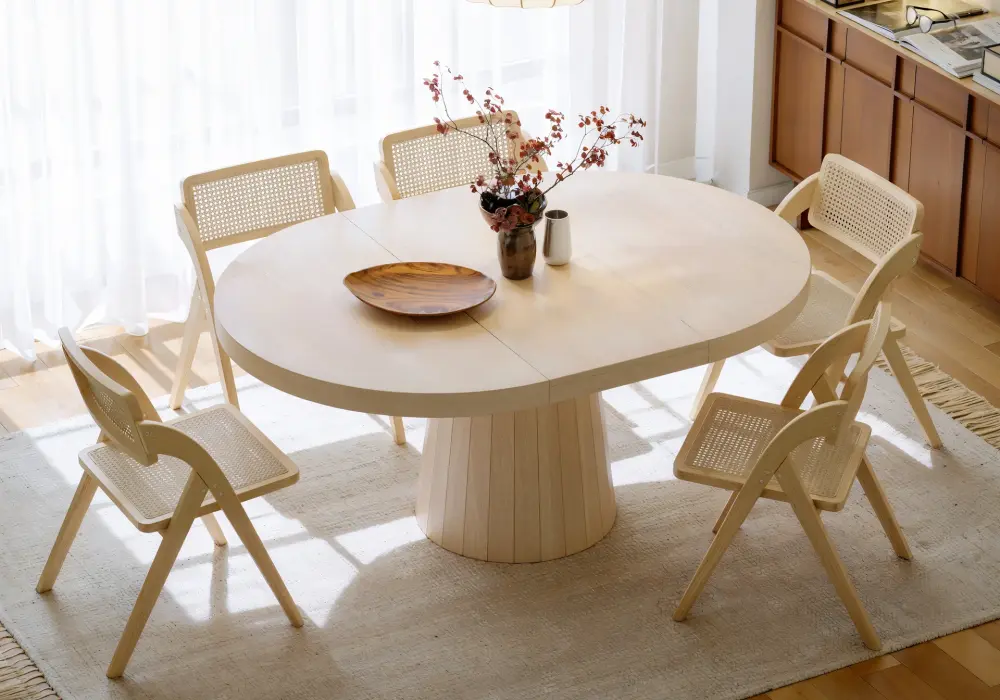
If you own an extendable dining table, size the rug for the largest configuration you regularly use, not the smallest everyday configuration.
For instance, if a table measures 60 inches closed but extends to 84 inches for family gatherings, an 8' × 10' rug may work when the table is closed but become restrictive when fully extended.
If entertaining is a frequent part of your lifestyle, choosing the larger rug can be more practical than optimizing solely for the table's compact configuration.
Placement, Alignment, and Handling Benches or Built-In Seating
Once you have chosen the rug size, placement becomes just as important as the dimensions themselves.
A dining rug should generally be centered beneath the table rather than aligned exclusively with a nearby wall. In an open-concept home, however, the rug can also function as a visual boundary between the dining area and adjacent living or kitchen zones.
Center the Rug Around the Dining Zone
For a conventional dining room, center the rug with the dining table. This usually produces the strongest visual balance.
If the dining table is positioned beside a wall, window, or architectural feature, you may adjust the rug slightly to preserve the room's overall symmetry. The priority is to make the table and seating feel centered within the usable dining zone, rather than mechanically centering the rug in the entire room.
Dining Chairs and the Rug Edge
All frequently used dining chairs should ideally remain completely on the rug when pulled out.
If only the front legs remain on the rug while the rear legs sit on bare flooring, the chair can rock or catch as it moves. This is particularly noticeable with heavy upholstered dining chairs.
Benches Need a Different Calculation
A dining bench can reduce the amount of floor space needed for individual seating, but it can also require more movement when people pull it away from the table.
If a bench is used on one side of the table, measure its fully extended position rather than assuming the 18-inch rule automatically applies.
For example:
Table edge → bench front → maximum pull-back point
The rug should extend far enough to accommodate that movement.
If the bench is positioned against a wall and is rarely moved, you may not need as much clearance behind it. This is one situation where designing around actual use is more sensible than following a rigid rug-size formula.
Built-In Banquettes
A built-in banquette changes the equation again.
Because the seating is fixed against a wall, you do not need to pull the banquette backward. Instead, prioritize enough rug coverage for the table and the movable chairs opposite it.
This can make a slightly narrower rug practical in a dining nook, especially when the banquette sits along a wall and the room has limited floor space.
Source Homary
Choosing Rug Materials, Stain Resistance, and Pet-Friendly Options
Dining rooms are unusually demanding environments for rugs. Food crumbs, spilled drinks, chair movement, pets, and frequent foot traffic all put more stress on the floor covering than a decorative rug in a low-use room.
The best material depends on whether your priority is appearance, softness, easy cleaning, or long-term durability.
Material | Durability | Stain Resistance | Feel | Best For |
Wool | Excellent | Good | Soft, substantial | Premium dining rooms |
Polypropylene | Good | Excellent | Medium | Kids and pets |
Polyester | Moderate | Good | Soft | Budget-conscious rooms |
Nylon | Excellent | Excellent | Firm | High-traffic dining areas |
Natural fiber | Good | Moderate | Textured | Casual/coastal interiors |
Blends | Varies | Varies | Varies | Balanced performance |
Wool
Wool is a strong choice when appearance and longevity are priorities. It has a substantial texture and naturally resilient fibers, making it appropriate for formal dining rooms.
The trade-off is price and cleaning requirements. A wool rug can also show certain food or beverage stains more visibly depending on its color and construction.
Polypropylene
For families with children or pets, polypropylene is often a practical choice. It is commonly used for stain-resistant and easy-care rugs and can work particularly well in casual dining rooms.
A low-pile polypropylene rug is generally easier to vacuum and less likely to interfere with dining chair movement than a deep-pile design.
Nylon
Nylon is worth considering when the dining room sees heavy daily traffic. It tends to prioritize durability and resilience over the softer, more luxurious feel associated with wool.
Natural Fibers
Jute and other natural-fiber rugs can complement coastal, farmhouse, and relaxed modern interiors. Their textured appearance adds visual warmth, but they are not always the first choice when frequent liquid spills and intensive cleaning are major concerns.
For households with young children, pets, or frequent entertaining, stain resistance and cleanability should generally take priority over texture alone.
Rug Pads, Installation, Measurement Checklist and Custom Sizing
Source Homary
A rug pad is not simply an optional comfort layer beneath a dining room rug. It can improve grip, reduce movement, add cushioning, and help protect the flooring underneath.
For dining areas, avoid choosing a pad so thick that it makes chairs difficult to move. A relatively low-profile, dense pad is usually more practical than a thick cushioned pad.
For hard flooring, look for a pad designed specifically for the surface, such as hardwood or tile. Materials may include felt, rubber, or combinations of both. A dense felt pad can provide cushioning, while a thin rubberized layer can improve grip.
Rather than assuming one thickness works for every rug, match the pad to:
- Rug construction
- Floor material
- Chair movement
- Desired cushioning
- Manufacturer recommendations
A Simple Pre-Purchase Measurement Checklist
Before ordering your rug, complete these measurements:
- Measure the table. Record its full length and width or diameter.
- Measure the chairs. Pull each chair out to its normal sitting position and measure the distance from the table edge to the chair's back.
- Check the largest seating configuration. For an extendable table, measure the table at its fully extended length.
- Mark the rug footprint. Use painter's tape on the floor to create the proposed rug outline.
- Test the chairs. Pull every chair backward and forward several times. Make sure the rear legs remain supported by the rug.
- Check surrounding walkways. Make sure the rug does not create an awkward obstruction between the dining area, kitchen, living room, or entry.
- Add the rug pad. Choose a pad that fits the rug dimensions without creating exposed edges.
Painter's tape is especially useful because it lets you test an 8' × 10' versus a 9' × 12' footprint before spending money. In an open-plan room, this simple step can reveal that a theoretically correct rug size overwhelms the surrounding furniture.
When Should You Choose a Custom Rug?
Custom sizing becomes useful when your dining room has an unusual shape, built-in seating, an oversized table, or architectural obstacles.
It can also make sense when the standard 8' × 10' and 9' × 12' sizes both create compromises. For example, a narrow dining area might have enough length for a large rug but not enough width for the corresponding standard size.
In that situation, custom sizing can preserve chair clearance without sacrificing the room's walkways.
Build the Dining Room Around the Table, Not Just the Rug
A dining rug works best when it is considered as part of the entire dining configuration.
Start with the table size and seating capacity. Then determine how far the chairs need to move. From there, choose the rug footprint, material, and rug pad.
For most dining rooms, the 18-inch minimum and 24-inch preferred overhang provides a useful starting point. An 8' × 10' rug is a versatile choice for many six-person rectangular tables, while larger tables, generous chairs, or open dining areas may call for a 9' × 12' rug.
The final decision should balance three priorities:
Comfort: Chairs need enough room to move.
Proportion: The rug should visually anchor the table.
Traffic flow: The dining zone should remain connected to the rest of the room without creating a cramped perimeter.
Before purchasing, tape the proposed dimensions onto the floor and test the chairs. That five-minute exercise can tell you more about the correct rug size than simply comparing product photos online.
Ready to Choose Your Dining Rug?
Once you know your table dimensions, seating configuration, and available floor space, shopping becomes much easier. Save those measurements and use them to compare rug sizes, materials, and rug-pad options rather than choosing based on appearance alone.
A good dining room rug should make the entire arrangement feel intentional—from the table and chairs to the surrounding walkways—not simply fill the empty floor beneath the table.
FAQ
How much rug should extend beyond a dining table to allow chairs to be pulled out comfortably?
A dining rug should extend at least 18 inches beyond the table edge, with 24 inches preferred when space allows. This gives dining chairs enough room to move backward while keeping their legs on the rug. For larger upholstered chairs or frequently used seating, additional clearance may be worthwhile.
What rug size works best for a 6-person rectangular dining table?
For a typical 60- to 72-inch-long six-person dining table, an 8' × 10' rug is a common starting point. If the table is closer to 72 inches, the chairs are particularly deep, or the room is spacious, a 9' × 12' rug can provide more generous clearance.
Can I use a rug with bench seating or a built-in banquette, and how should sizing change?
Yes. With a movable bench, measure the bench in its fully pulled-out position because it may require more clearance than individual chairs. A built-in banquette does not need rear clearance because it stays against the wall, so the rug can be sized primarily around the table and movable chairs.
Should dining room furniture legs sit on the rug or off the rug, and what are the trade-offs?
For dining tables and chairs, keeping the table and chairs on the rug generally creates the most cohesive arrangement. The important point is that chairs should remain supported by the rug when pulled out. A rug that is too small may leave the rear chair legs on bare flooring, making chairs harder to move and potentially catching the rug edge.
Which rug materials are easiest to clean and most stain-resistant for dining rooms with kids or pets?
Polypropylene and nylon are practical choices when stain resistance, durability, and easy maintenance are priorities. Low-pile constructions are also easier to vacuum and tend to allow dining chairs to move more smoothly. Wool offers a more premium feel and excellent durability but may require more careful cleaning.
Do I need a rug pad under a dining-room rug, and what thickness and material should I choose for hardwood floors?
A rug pad is generally useful because it can reduce slipping, add cushioning, and help protect the floor. For dining rooms, choose a relatively low-profile pad that does not make chairs difficult to move. On hardwood, use a pad specifically labeled as safe for hardwood flooring, with felt, rubber, or a compatible combination depending on the rug and floor.