

UV resistant patio furniture is designed or specified to resist particular effects of sunlight, such as fabric fading or deterioration of an exposed component. When comparing outdoor furniture, identify which part carries the claim: cushions, rope weave, frame finish, and wood can have different performance and maintenance needs. A weather-resistant label is a good starting point, and the component-level details tell you how each part will perform in the sun.
The most useful choice combines suitable materials with evidence you can understand and a care routine you will follow. Look beyond whether a set is described as all-weather: find out what is tested, what to confirm with the seller, and what the manufacturer recommends between uses.
This guide explains how to read those details so you can choose with confidence and set realistic expectations for how furniture looks and feels over time.
Table of Contents
Distinguish UV Resistance From Other Outdoor Features
Several desirable features are often listed together, but they answer different questions. A fabric may resist spills while its colorfastness is documented separately. A frame may resist corrosion, and its decorative finish has its own sunlight performance to check.
Claim or feature | What it helps you investigate | What to pair it with |
UV resistance | The stated sunlight-related performance of a component | Care guidance and warranty terms for long-term outlook |
Fade resistance | Retention of appearance under specified exposure | Information on stain, abrasion, and moisture wear |
Water resistance | Response to moisture under stated conditions | A separate UV or colorfastness specification |
Rust resistance | Corrosion-related properties of relevant metal parts | Finish and coating details; cushion specifications |
Removable covers | Whether upholstery can be taken off | Washing instructions and replacement-cover options |
Read the claim and its subject together. "UV-resistant cushions" is more specific than a headline about an outdoor-ready set, and it becomes even more useful when you add the test conditions, cleaning requirements, and warranty coverage.
Furniture durability statements describe the furniture. If shade is part of the plan, check the shade product's own specifications for personal sun protection.
Material Quick Guide: Fabric, Rope, Metal, and Teak
Use this overview as a starting point, then confirm the specifics for the exact product you are considering. Performance varies by fiber, finish, and manufacturer.
Material | UV performance | Care level | Best suited for |
Performance fabric (e.g., solution-dyed cushions) | Strong when the color is built into the fibers; request the lightfastness result for the exact fabric | Low to moderate: regular rinsing or washing per the care label | Sunny patios where cushions stay out through the season |
Synthetic rope weave | Good when the fibers are described as UV- or fade-resistant; confirm the scope of the claim | Low: periodic wiping or gentle cleaning | Lounge sets that need a lightweight, textured look |
Metal frame (e.g., aluminum with a protective finish) | Frame is typically stable in sun; the finish has its own specification to check | Low: wipe clean and follow the finish guidance | Open, exposed patios and low-maintenance setups |
Teak | Weathers gradually in sun toward a silvery-gray tone while keeping its character as a hardwood | Low if you enjoy natural aging; moderate if you prefer to keep the original warm color | Homeowners who like natural materials and are happy either to let the wood age or to follow a supplier-recommended routine |
Ask for Evidence That Matches the Component
A useful fabric specification identifies its construction or fiber composition and, where available, the lightfastness test method, result, and exposure duration. Those details make a comparison more meaningful than two competing marketing adjectives.
Colorfastness-to-light ratings for woven outdoor upholstery are a useful comparison tool, but laboratory test hours do not directly correlate with hours of service in the field. That makes a fabric rating most helpful for comparing materials tested under the same method.
Use the number of test hours to compare fabrics side by side, and use your own patio conditions (light, moisture, cleaning, and use) to judge how it will perform at home. Ask what result the material achieved under the stated method, and keep in mind that exposure time is a benchmark and not an expiry date.
If test data is not provided, treat the claim as a manufacturer or merchant description. It is still useful information, and requesting documentation lets you compare it confidently with fully documented alternatives.
Understand Fabric Construction Without Assuming a Brand
Solution dyeing is one construction detail worth asking about. In solution-dyed fabrics, color and UV-stabilized pigments are added to the fibers before yarn production, which is one concrete way a fabric's construction connects with fade resistance.
Fabrics described as performance canvas may use different processes, fibers, or formulations, so confirm the exact fabric you are considering and read its own specifications.
Also ask whether the stated performance applies to all color choices. A photograph of one finish shows how it looks, and the technical sheet for the specific cushion option shows how it performs.
Choose color for your home, then judge the material evidence on its own merits. Comparative data for your chosen shade is the most reliable way to know how it will hold up in sunlight.
Evaluate Rope, Frames, and Decorative Finishes Separately
Outdoor furniture often exposes several materials in the same view. Examine the rope or weave, the supporting metal or wood, and the tabletop as separate parts of the purchase.
For rope or synthetic weave, ask about the material and the scope of any fade or UV claim. A texture described as handwoven tells you about its appearance and construction, and the fiber specification tells you about its sunlight performance.
For a metal frame, look at corrosion-related statements and at coating or finish information together. Ask which cleaning products are recommended and how scratches or finish damage should be handled, and use only treatments the manufacturer approves for that surface.
For decorative wood-look finishes, establish the underlying material too. A teak-colored surface on a metal component and a solid-wood part can look alike while following different care routines, so confirm which one you are buying.
Three Homary Options for Different Patios
These products illustrate distinct material combinations, and each one includes a quick note on who it suits best.
Rope Weave With UV- and Water-Resistant Cushions
The Cocaro 4-Piece Outdoor Handwoven Rope Sofa Set combines an aluminum frame, woven detailing, and outdoor cushions. Homary's description specifically identifies the cushion fabric as UV- and water-resistant and describes the rope weave as fade-resistant.
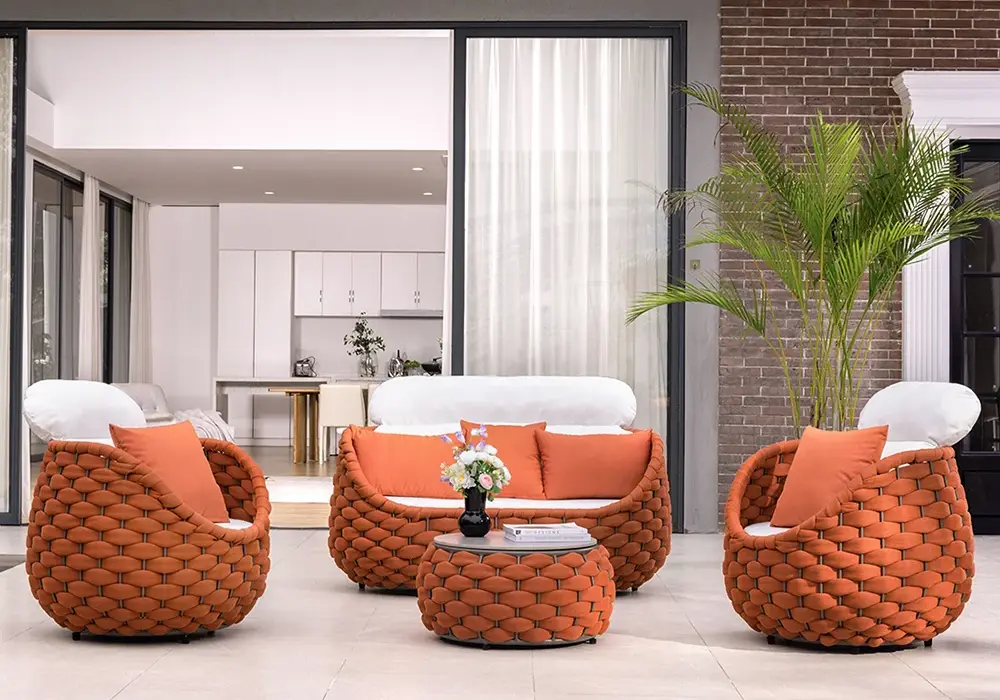
The UV claim is stated component by component, covering both the cushion fabric and the rope weave, and the listed removable covers make everyday upkeep convenient.
Who it suits: Buyers who want a sunny-patio conversation set with the UV claim stated directly for both the cushions and the rope. The aluminum frame and removable covers also make it a good fit for anyone who values easy upkeep, and the set works well on a patio or deck that gets plenty of direct light.
A Teak Deep-Seat Sofa With Warm-White Covers
The Resaro Outdoor Teak Deep-Seat Low-Profile Sofa is described with a weather-resistant teak frame and warm-white performance covers. Its current description emphasizes stain resistance and outdoor construction.
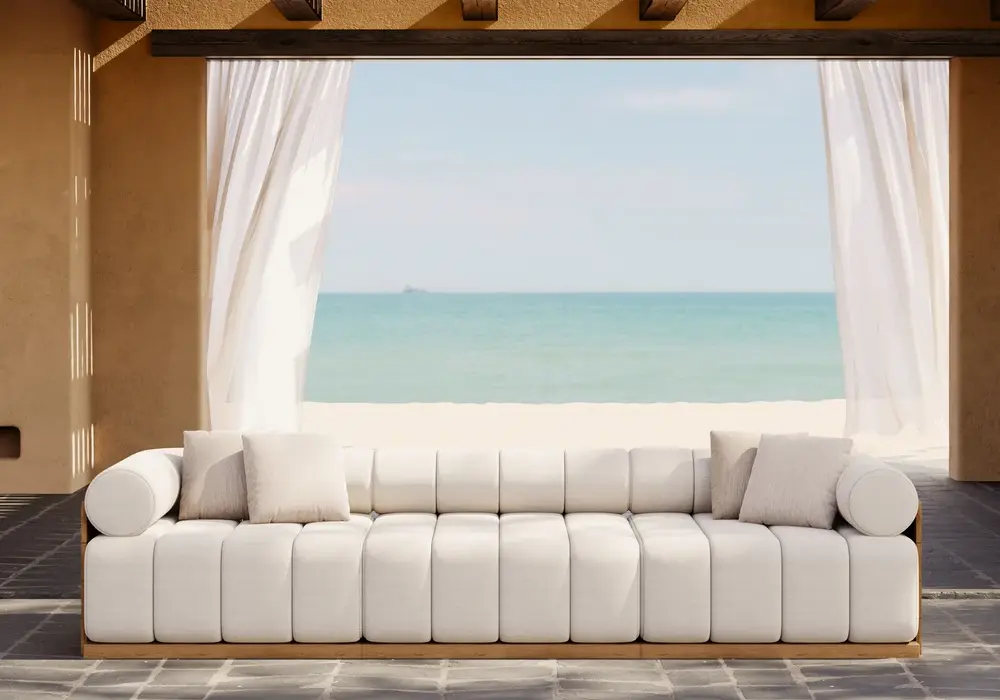
The wood's weather resistance and the cover's stain resistance each address a different outdoor need, and the teak will mellow naturally over time, which is part of the appeal of a natural material.
Who it suits: Buyers who love the look of natural teak and a deep, relaxed seat, and who want a compact three-seater for a porch, a covered patio, or a smaller outdoor corner. It is a good match if you enjoy warm-white tones and are comfortable letting the wood develop its natural patina, or following the supplier's care guidance to keep its original color.
A Modular Teak Set With a Fire-Pit Table
The Grida 10-Piece Outdoor Teak Modular Sofa Set with Fire Pit combines teak seating, cushions, and a propane fire-pit table. Its specification lists UV resistance under frame durability and water resistance under cushion durability.
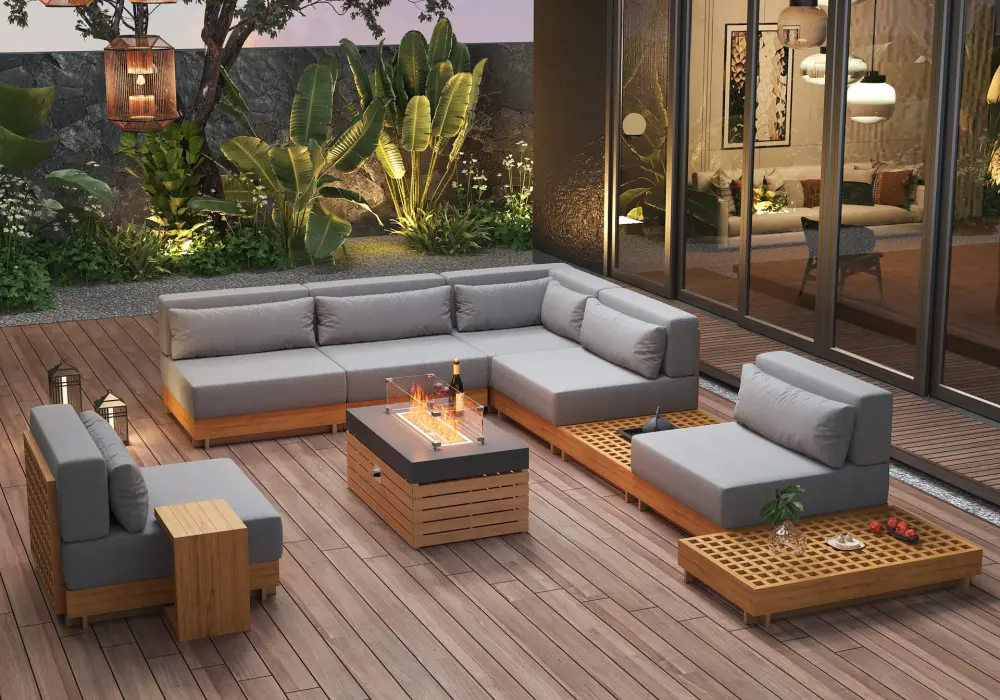
The two descriptions work together: the frame carries the UV description, and the cushions carry the water-resistance description, so the main components each have a stated outdoor feature. The propane fire-pit table adds a focal point to the layout.
Who it suits: Buyers who entertain and want one large, flexible arrangement for a spacious patio or backyard. The modular layout lets you reconfigure seating, and the fire-pit table makes it a natural centerpiece for evening gatherings.
Match the Furniture to the Exposure You Actually Have
Observe where direct light falls during the hours you use the patio. Note which seat backs and cushions remain exposed longest and whether the pattern changes with the season.
This is a practical placement exercise. Its purpose is to help you decide where shade and care effort will be most useful. A covered area can still receive direct low-angle sun from one side, so it is worth checking at different times of day.
If you use an umbrella or another shade system, plan its actual footprint and position alongside the furniture. Check its anchoring and operating instructions, and follow the manufacturer's guidance on when to keep it deployed or closed.
Choose a location and routine you can maintain consistently. A simple arrangement with appropriate protection when the furniture is unused often works better than a detailed plan that requires moving a heavy set every day.
Use Covers and Cleaning as Part of the Plan
Select and use a cover according to the furniture manufacturer's instructions. Measure the actual configuration and allow components to dry as directed before covering them.
Follow the instructions for ventilation, drying, and seasonal storage, because a well-matched cover works best as one part of a complete care routine.
Clean with the recommended method and products. Removable covers can make some tasks easier, and the care label will confirm whether they can go in the washing machine, so check it before removing a cover for cleaning.
Keep a manageable inspection routine. Look at seams, exposed surfaces, and frequently used contact areas while cleaning. If something changes, record it and ask the supplier about the appropriate response, so any treatment you use is one they recommend.
Compare Replacement Options and Warranty Terms
The ability to replace a cover or cushion can matter as much as its initial appearance. Ask whether replacement parts are available for the exact model, fabric, and size, so you know the replacement will fit.
Review what any warranty says about fabric, finish, and outdoor exposure. Read the coverage details, exclusions, and care requirements that apply to the component you are evaluating, so you know exactly what is included.
Keep the product information and care instructions with the order record. If a performance claim affects your choice, save its wording so you can refer back to exactly what was specified.
Prioritize the whole ownership routine: suitable dimensions, useful seating, documented materials, practical maintenance, and parts support. UV resistance is one important part of that decision, alongside the other features that make a set enjoyable to use.
Questions to Confirm Before You Buy
Once you have a favorite, a few quick questions to the seller will help you compare options on equal terms:
- Fabric: Is lightfastness test information available for the exact cushion fabric, and does the stated performance apply to the color you selected? A photograph shows how a finish looks, and the technical sheet for that cushion option shows how it performs.
- Care: What are the recommended cleaning method and products for each material, and can the removable covers be machine-washed?
- Replacements: Are replacement covers or cushions available for the exact model and size?
- Fire-pit units: What are the operating and installation requirements for the fire-pit table, which are separate from the materials' sunlight performance?
Choose the color you love for your home, then use these answers to compare options with confidence.
Frequently Asked Questions
Does UV resistant mean patio furniture will never fade?
UV resistance means a component is designed or specified to handle sunlight well, and the best way to judge how well is to look at the evidence behind it. Identify the component, review the test information and exposure conditions, and read the warranty's scope to understand what long-term performance to expect.
Is water-resistant outdoor fabric also UV resistant?
Water resistance and sunlight-related colorfastness are two separate properties, so look for a statement or test information for each one on the actual cushion fabric. Many sets offer useful moisture resistance, and asking for the lightfastness details completes the picture.
Can test hours tell me how many years furniture will last?
Test hours are a helpful way to compare fabrics under the same method. Laboratory lightfastness hours do not directly correlate with field service hours, so ask for the test method and result, then consider how the material will be exposed and maintained in your setting.
What should I ask before buying UV resistant patio furniture?
Ask which components carry the claim, whether fabric test information is available, what cleaning and protection are recommended, and whether replacement covers or cushions can be ordered. Confirm the warranty terms and the selected color's specifications, in addition to the collection headline.