

A small wood round drum coffee table can anchor a living room while keeping the center of the space free from sharp corners. The challenge is finding a table that feels substantial without overwhelming a compact layout. Diameter matters, but so do height, sofa clearance, walking space, and the visual weight of the drum-shaped base.
A true drum coffee table has a broad, continuous base beneath a round top, giving it a more solid appearance than a round table with slim legs. Wood adds warmth and texture, while details such as slatted or fluted construction can change the look without changing the basic drum form.
Before choosing a small round drum coffee table, measure the available space, consider how the table will work with your sofa, and decide whether storage or a lift-top is genuinely useful. The goal is not simply to find a small table, but to find one that fits the room and remains comfortable to use.
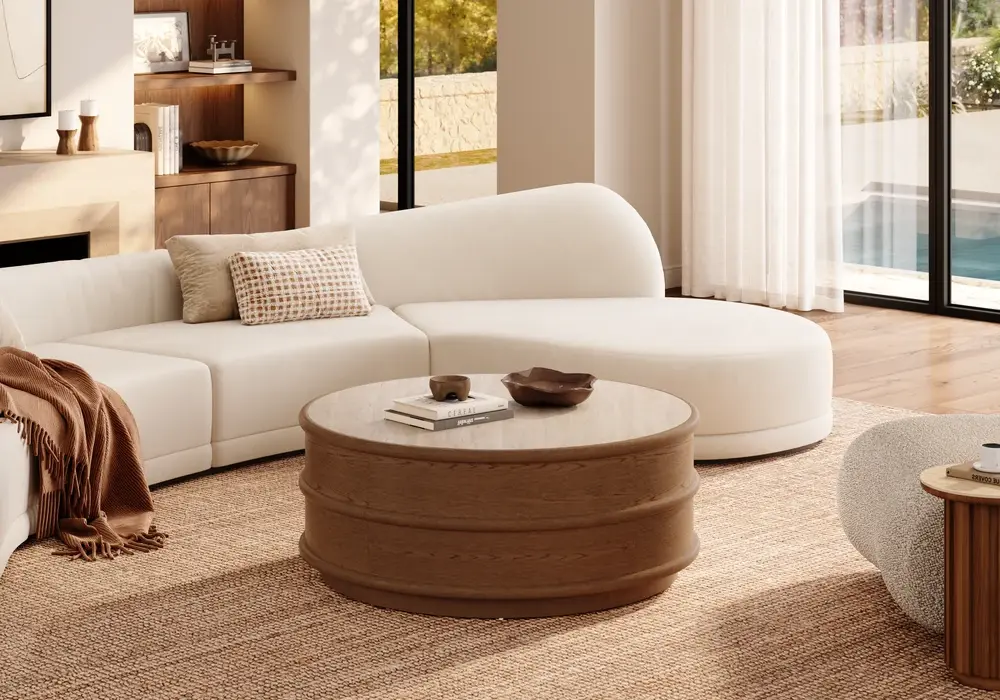
36" Ash Wood Round Coffee Table
Table of Contents
What Is a Wood Round Drum Coffee Table?
A wood round drum coffee table has two defining characteristics: a circular tabletop and a broad base that creates a continuous, drum-like silhouette. Unlike a traditional coffee table with four separate legs, the base extends across much of the area beneath the top.
The shape gives the table a strong presence in the seating area. That can be an advantage when the room needs a clear visual anchor, but it can also make the table look heavier than its diameter suggests.
What Makes a Coffee Table Drum-Shaped?
The base is what distinguishes a drum coffee table from a standard round coffee table.
A drum base may be smooth, paneled, slatted, or fluted. The surface treatment can vary considerably while the overall form remains cylindrical or enclosed.
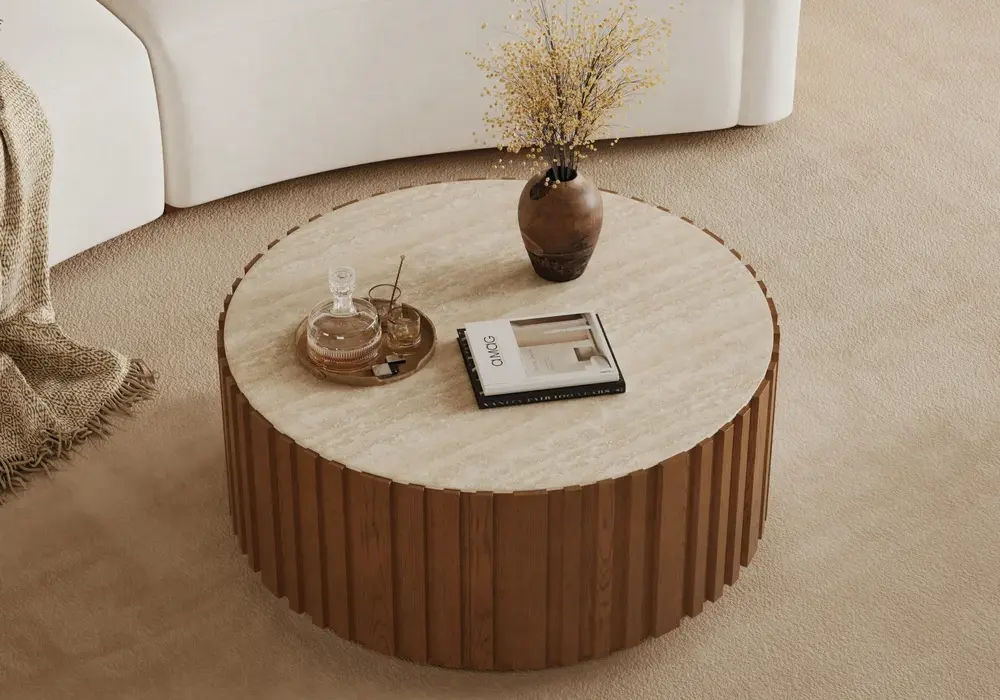
For example, the Aura 35" Ash Wood Slatted Round Coffee Table with Sintered Stone Top uses vertical ash wood slats around a broad circular base. The slatted surface adds texture while preserving the substantial form associated with a drum-style coffee table.
How Is a Drum Coffee Table Different From a Regular Round Table?
A round tabletop does not automatically make a table a drum table.
A round coffee table with open legs leaves more floor visible underneath. A drum table creates a larger visual block in the center of the room. This difference is especially noticeable in a small living room, where furniture can quickly make the space feel crowded.
Choose a drum shape when you want a grounded, sculptural look. Choose a more open base when keeping the room visually light is the higher priority.
What Size Is Best for a Small Round Drum Coffee Table?
There is no universal diameter that defines a “small” round drum coffee table. The right size depends on the available floor area, the sofa, and how many people need to use the tabletop.
Rather than choosing the smallest diameter available, find the smallest size that still works for the seating arrangement.
What to measure | Why it matters |
Diameter | Determines the table's floor footprint |
Height | Affects reach and proportion to the sofa |
Sofa-to-table distance | Determines comfortable everyday access |
Walking space | Keeps circulation routes usable |
Seating position | Shows which seats need direct access |
Choose Diameter Based on Usable Space
A smaller diameter leaves more room around the table, but it also reduces the amount of surface available.
For a compact seating area, a smaller tabletop may be enough for a drink, remote, and book. With a longer sofa or more active household, a slightly larger table may be more useful even if the room is relatively small.
The better question is not “How small can the table be?” but “How small can it be while still serving the main seats?”
Consider Height as Well as Diameter
A round drum table should be proportionate to the sofa seat. A table that is too low may be awkward to reach, while one that is too high can feel visually dominant.
Compare the tabletop height with the sofa and think about how you normally sit and reach. With a lift-top design, consider both the closed height and the operating position.
Small Does Not Always Mean Visually Light
An enclosed drum base can make a relatively compact table look substantial.
That visual weight can work well with a light sofa or open furniture. In a room with a deep sectional, bulky chairs, or limited visible floor, the same table may feel larger than expected.
This is why size should be evaluated from both the floor plan and the seated view.
How Much Space Do You Need Around It?
The table should fit the way people move through the room, not just fit between two pieces of furniture on paper.
Sofa-to-Table Clearance
As a practical starting point, allow approximately 16–18 inches (41–46 cm) between the sofa front and the coffee table.
This is a starting range rather than a fixed rule. Adjust it based on sofa depth, cushion position, seated reach, and mobility needs.
A narrow gap may work when the table is used mainly from the sofa, while a route used for regular foot traffic needs more room.
Walking Clearance Around the Table
The round edge eliminates sharp corners, but the table still occupies its full diameter.
Before buying, mark the proposed footprint on the floor with removable tape or a paper template. Sit on the sofa, stand up, walk around the table, and test the routes toward nearby chairs and doorways.
This simple test can reveal whether the table is too large before you commit to it.
Check the Operating Space
Moving features need to be included in the fit test.
A drawer needs space to open. A lift-top needs clearance as it rises. A rotating surface needs room to move without hitting nearby furniture.
For a small room, the operating footprint can matter just as much as the table's closed footprint.
How Should It Fit Your Sofa and Living Room?
A small wood round drum coffee table should support the seating arrangement without making the center of the room feel blocked.
Match the Table to the Sofa Length
A compact table usually works best when the main seats are close enough to reach it comfortably.
With a longer sofa, a very small table may leave the seats at either end too far away. Moving the table closer to improve reach can then reduce the space needed to move around it.
In some layouts, a smaller central table paired with a side table is more practical than choosing a larger coffee table.
Consider Sectional Sofas
A small round drum coffee table can work well with an L-shaped sectional when it sits comfortably inside the open portion of the seating arrangement.
Measure the actual distance between the seating fronts rather than relying on the sectional's overall width. Check the inside corner, the chaise, and the main walking route around the table.
The table should be reachable from the seats people use most without making the sectional feel boxed in.
Balance the Visual Weight
A drum table naturally creates a strong central mass.
A lighter room with slim furniture can usually accommodate that weight more easily than a room already filled with deep upholstery and substantial pieces. Wood grain, slats, fluting, and tabletop color can further affect how prominent the table appears.
The best choice balances the table's physical size with the amount of visual space around it.
What Features Should You Look for in a Small Drum Coffee Table?
Once the size and placement work, focus on features that solve a real everyday need. In a small room, extra functions should improve usability without making the table harder to operate.
Feature | Best suited to | What to consider |
Fixed top | Simple everyday use | Stable surface and easy access |
Lift-top | Work or dining from the sofa | Raised position and clearance |
Drawers | Concealing small items | Opening space and accessibility |
Rotating top | Access from different seats | Movement path around the table |
Fixed Tops Keep the Layout Simple
A fixed top is a straightforward option when the coffee table mainly holds drinks, books, remotes, or a few decorative pieces.
It also has a predictable footprint because there are no moving parts to account for during normal use.
Lift-Top Designs Add Function
A lift-top can make a drum-style coffee table more versatile by providing a different working position while retaining the rounded, substantial form.
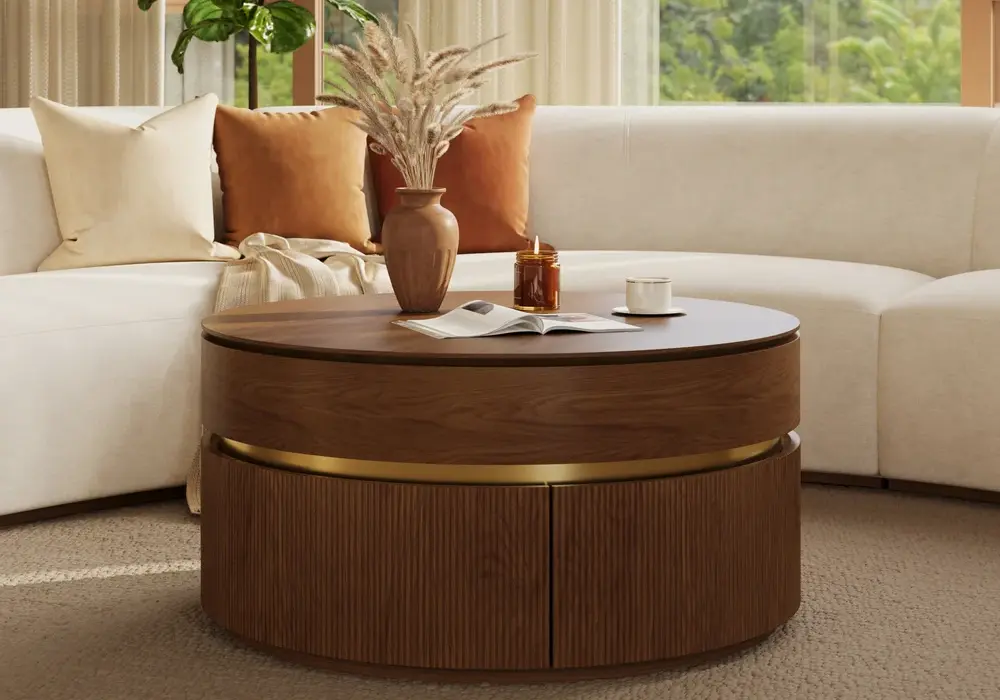
The 32" Fluted Lift-Top Round Walnut Coffee Table with 2 Drawers is an example of this approach. Its fluted round base gives it a drum-style appearance, while the lift-top and drawers add functionality for a living room that needs more than a fixed surface.
Choose Storage Based on Your Routine
Storage is useful when it removes clutter you regularly deal with.
Drawers can hold remotes, charging cables, and other small items. Concealed storage creates a cleaner appearance, while open storage makes access easier but leaves contents visible.
Choose only as much storage as you are likely to use. Additional compartments are not useful when they make the table larger or more complicated without solving a specific problem.
Check the Wood Construction
“Wood” does not necessarily mean solid wood.
A round drum coffee table may use solid wood, veneer, engineered wood, or a combination of materials. A finish described as “natural” refers to appearance and does not by itself establish the construction.
Read the material specification before buying, especially when you want the table to coordinate with existing wood furniture.
Care instructions should also match the particular finish. Avoid assuming that the same cleaning method applies to every wood surface.
Keep the Tabletop Functional
A drum base already gives the table visual weight, so the surface usually does not need to be heavily decorated.
A low bowl, short vase, or compact tray can add a finished look while leaving room for a drink or book. For a lift-top table, keep decorative objects away from the moving section.
The table should still be easy to use after it has been styled.
Frequently Asked Questions
What is a wood round drum coffee table?
A small wood round drum coffee table is a coffee table with a circular top and a broad, substantial base that creates a drum-like silhouette.
What size is considered a small round drum coffee table?
There is no single official size. A table is small when its footprint is appropriate for the available room and seating while still providing enough surface for everyday use.
Is a drum coffee table good for a small living room?
It can be. The round edge works well around walking paths, while the enclosed base creates a strong visual anchor. The main consideration is whether the drum base adds too much visual weight to an already crowded room.
How far should a small round drum coffee table be from the sofa?
Approximately 16–18 inches is a useful starting point. The ideal distance depends on the sofa, seated reach, and whether people need to walk through the space around the table.
Can a small round drum coffee table work with a sectional?
Yes. Measure the open space inside the sectional and make sure the table does not interfere with the chaise, inside corner, or main walking route. The primary seats should also be able to reach the tabletop comfortably.
Does a drum coffee table have to be solid wood?
No. Drum describes the shape rather than the material. A drum coffee table can use solid wood, veneer, engineered wood, or mixed materials. Check the product specification instead of judging the construction from appearance alone.