

A TV stand is often the visual anchor of a living room, but decorating around it can be surprisingly tricky. Too little decor can make the wall feel empty and unfinished, while too many accessories can compete with the screen and make the whole space look cluttered.
The good news? You don't need a complete makeover to turn your TV wall into a design feature. With a few simple tricks, you can create a space that feels balanced, intentional, and inviting. The key is to start with the right layout, use proportion to create visual harmony, style your TV stand in layers, hide distracting cables, and add lighting that enhances the room without creating screen glare.
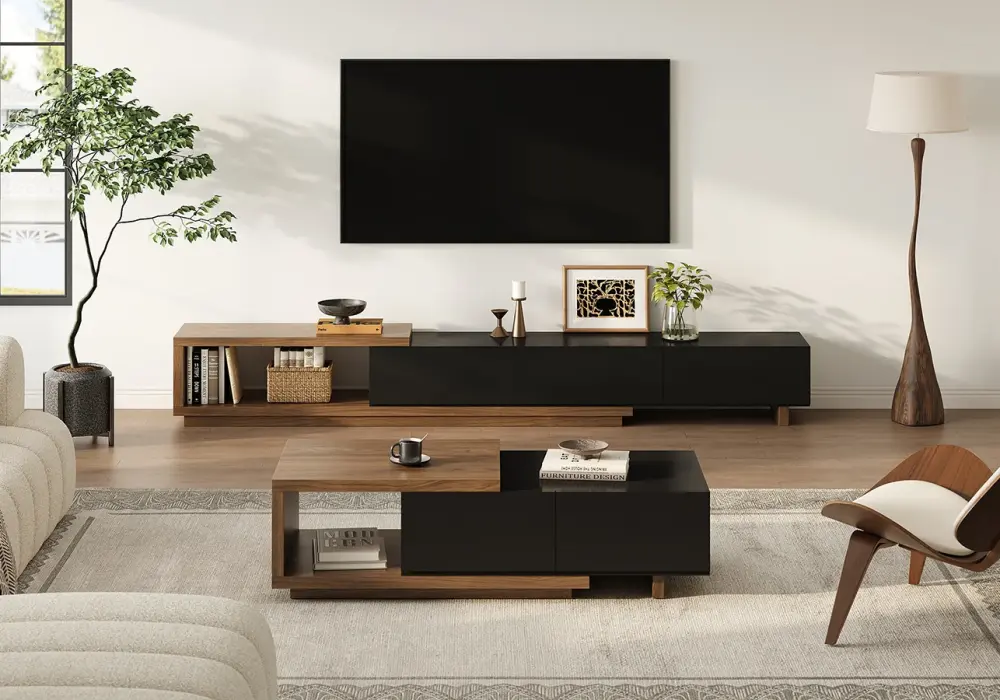
Quoint 71"-100" Extendable TV Stand of Homary
Table of Contents
Plan Your Layout: TV Placement & Room Flow Before You Decorate
Before buying artwork, books, baskets, or decorative objects, start with the layout. Good decorating begins with knowing how much space you actually have.
First, measure the width and height of your TV and TV stand. Then consider the distance between the sofa and the TV wall. This helps you decide whether the TV looks better wall-mounted or placed directly on the stand.
If you are mounting the TV, aim for a comfortable viewing position where the center of the screen is roughly at eye level when you are seated. If the TV sits on a stand, make sure the stand is wide and stable enough to visually support the screen.
Most importantly, don't fill every inch around the TV. Leave enough open floor space for people to walk comfortably through the room. A beautiful TV wall should still feel functional.
The Rule of Balance: How to Style Wall Decor Around a TV Without Overwhelming It
This is where the difference between “decorated” and “well designed” becomes obvious.
The TV is already a large, dark rectangle, so the surrounding decor needs to create balance without competing for attention. Think of the screen as the visual center and everything around it as supporting elements.
Start With Scale
One of the most common decorating mistakes is choosing wall art that is too small. A tiny frame beside a large television can look disconnected and accidental.
As a general rule, artwork placed beside the TV should have enough visual weight to balance the screen. For a large TV, consider one larger piece or a small grouping rather than several tiny frames.
Leave some breathing room between the television and nearby artwork. Around 4–12 inches of visual space is often a good starting point, depending on the size of the TV and the wall. The larger the overall arrangement, the more generous the spacing can be.
You can also use the TV centerline as a reference point. Wall decor does not have to be perfectly symmetrical, but it should feel visually connected to the screen and TV stand.
Think About the Entire Wall, Not Just the TV
Instead of asking, “What should I put next to the TV?” ask, “How do I make this entire wall feel balanced?”
For example, if the TV is mounted slightly off-center, you may need a taller decorative element on one side to visually compensate. A floor lamp, tall plant, narrow bookshelf, or oversized artwork can work well.
For artwork above the TV stand, keep the composition proportional to the furniture below it. A useful starting point is to make the artwork or gallery arrangement around two-thirds to three-quarters of the width of the TV stand. This creates a connected visual zone without making the wall feel cramped.
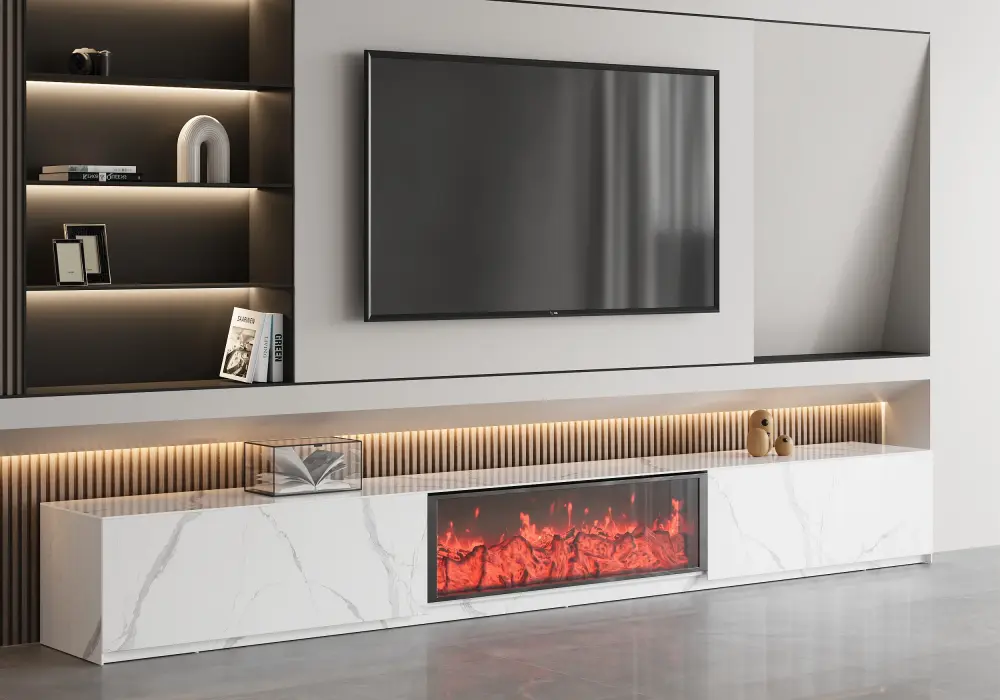
Sintered Stone LED Flame TV Stand of Homary
Use Symmetry—or Controlled Asymmetry
Symmetrical styling is usually the easiest approach. Two matching lamps, plants, vases, or baskets can create an instant sense of order.
However, perfect symmetry is not essential. Asymmetrical arrangements can feel more relaxed and sophisticated when the objects have similar visual weight.
For example:
- Left side: tall plant + small ceramic vase
- Right side: table lamp + stacked books
The objects are different, but the overall height and visual weight remain relatively balanced.
Match the Style to the Room
The decorating formula should also reflect the character of your home.
Interior Style | TV Wall Ideas | Best Decorative Materials |
Modern Minimalist | One oversized artwork, sculptural object, simple plant | Glass, metal, matte ceramic |
Modern Farmhouse | Framed landscape, woven baskets, greenery | Wood, rattan, linen |
Urban Apartment | Gallery wall, floor lamp, statement objects | Black metal, concrete, glass |
Scandinavian | Neutral artwork, soft textiles, simple ceramics | Pale wood, wool, stone |
In a modern minimalist room, for example, a large abstract print and one sculptural vase may look better than a dozen small accessories. In a farmhouse-inspired space, woven baskets, wooden frames, and natural greenery can soften the technology of the TV.
Avoid These Common Proportion Mistakes
A few styling errors appear again and again.
The first is using artwork that is too small. The second is placing decorative objects too close to the television, making the entire wall feel crowded. Another common mistake is creating “visual noise” by mixing too many colors, patterns, and materials.
A simple test is to step back several feet and look at the wall as a whole. Your eyes should naturally land on the TV first, then move around the supporting decor. If your artwork or accessories immediately demand more attention than the screen, simplify the arrangement.
Style the TV Stand & Shelves: Layering Decor, Color, and Seasonal Touches
Once the wall layout is right, turn your attention to the TV stand itself.
The easiest way to make a TV stand look professionally styled is to think in layers rather than filling the surface with random objects.
Step 1: Start With One Tall Element
Begin with the tallest item, such as a table lamp, vase, plant, or decorative branch. This establishes the vertical shape of the arrangement.
Next, add medium-height objects and finish with a few low pieces. The goal is to create an easy visual rhythm rather than a flat row of objects.
A simple formula is:
Tall + medium + low + empty space
For example, place a tall vase on one end, a small framed photo or candle beside it, and a short stack of books in front. Leave part of the TV stand completely empty.
Negative space is just as important as decoration.
Step 2: Mix Materials
A room feels more sophisticated when every object does not have the same texture.
Try combining:
- Warm wood for natural character
- Metal for structure and contrast
- Glass for a lighter visual effect
- Ceramic for softness
- Woven baskets for texture
You do not need all of these at once. Two or three materials are usually enough to create variety without making the TV stand look busy.
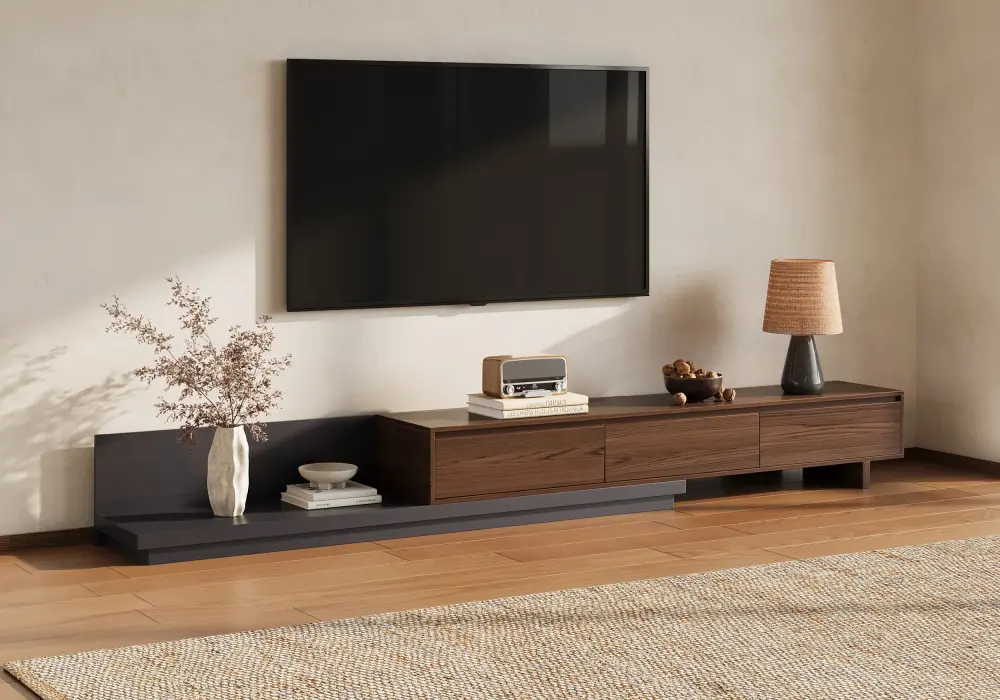
Fero 79"-142" Extendable TV Stand of Homary
Step 3: Repeat Colors Around the Room
Color repetition is one of the easiest ways to make decor feel intentional.
Look at the existing colors in your room and choose two or three tones to repeat. For example, if your sofa has beige cushions and your rug contains warm brown accents, repeat those shades through books, ceramics, artwork, or baskets around the TV.
You can also use black as a connecting color. A black TV can look more integrated when small black accents appear elsewhere, such as a lamp base, picture frame, or metal sculpture.
Step 4: Style Open Shelves in Sections
If your TV stand includes open shelving, avoid putting something on every shelf.
Instead, divide the storage into visual zones. One shelf might hold books and a small plant, while another contains baskets or a larger decorative object.
Vary the orientation of books as well. Some can stand vertically, while a small stack can lie horizontally underneath a decorative object.
This creates height variation and keeps the shelves from looking like a storage closet.
Step 5: Hide Functional Items Inside Decorative Storage
Remote controls, game controllers, charging cables, and other everyday items can quickly ruin a carefully styled TV stand.
Use attractive boxes, baskets, or lidded containers to keep small items out of sight.
Choose storage that matches the room instead of treating it as an afterthought. Woven baskets work well in warm, casual spaces, while sleek boxes or drawers suit contemporary interiors.
A Budget-Friendly Shopping Strategy
You don't need to buy an entire collection of new decor. Build your setup in layers based on your budget.
Budget | What to Add First | Decorating Goal |
Low | Books, thrifted frames, small plants, baskets | Add texture and personality |
Medium | Lamp, artwork, ceramic pieces, decorative boxes | Create a finished focal point |
Higher | Large artwork, designer lamp, statement vase, custom shelving | Build a cohesive feature wall |
Start with pieces that have the biggest visual impact, such as artwork or lighting, before buying lots of small accessories.
Keep Small Spaces Light and Flexible
For a studio apartment or small living room, avoid oversized accessories that reduce the sense of space.
Choose slim-profile decor, wall-mounted shelves, small plants, and multifunctional baskets. A narrow TV stand with closed storage can often look cleaner than a bulky entertainment unit filled with objects.
Renters can create a similar effect without drilling by using leaning artwork, freestanding shelving, removable hooks, and lightweight decorative pieces.
Choose Durable Decor for Homes With Kids or Pets
When children or pets share the space, beautiful decor should also be practical.
Favor baskets, wood, soft textiles, rounded ceramics, and sturdy low-profile objects. Avoid putting fragile glass pieces near the front edge of a TV stand or placing tall, unstable accessories where they can easily be knocked over.
Anchor or secure TVs and furniture according to the manufacturer's instructions, especially in homes with young children.
Refresh the Look Seasonally—Without Starting Over
Seasonal decorating does not require replacing everything.
Instead, keep the basic structure of your TV stand the same and swap a few accent pieces.
For spring, introduce fresh greenery and lighter ceramics. In summer, try woven textures and airy neutral colors. Autumn can bring warm wood tones, amber glass, and dried branches. For winter, add soft textiles, darker accents, or subtle seasonal greenery.
The trick is to rotate rather than add. When new seasonal decor comes in, remove a few existing pieces instead of piling everything together.
Hide TV Cables for a Clean, Styled Look
Even the most beautifully decorated TV wall can look unfinished when cables are visible.
Fortunately, you can often improve the appearance without major construction.
Cable raceways or cord covers can conceal wires running from a wall-mounted TV toward the TV stand. Many can be painted to blend with the wall.
For TVs sitting on a stand, use the back of the furniture to create a hidden cable path. Adhesive cable clips, cable sleeves, and cable boxes can keep multiple wires together and out of sight.
A simple approach is to group similar cables, route them behind the furniture, and leave only the necessary length exposed.
Cable-Hiding Option | Best For | Installation |
Adhesive cable clips | Small setups | No drilling |
Cable raceway/cord cover | Wall-mounted TVs | Usually adhesive |
Cable management box | Power strips and excess cords | Place behind or beside stand |
Keep cables away from areas where children or pets can pull on them, and avoid pinching or sharply bending electrical cords.
Use Lighting to Highlight Your TV Stand Decor & Reduce Glare
Lighting can transform a TV wall from a basic entertainment area into a cozy focal point.
The best approach is layered lighting rather than one bright ceiling fixture.
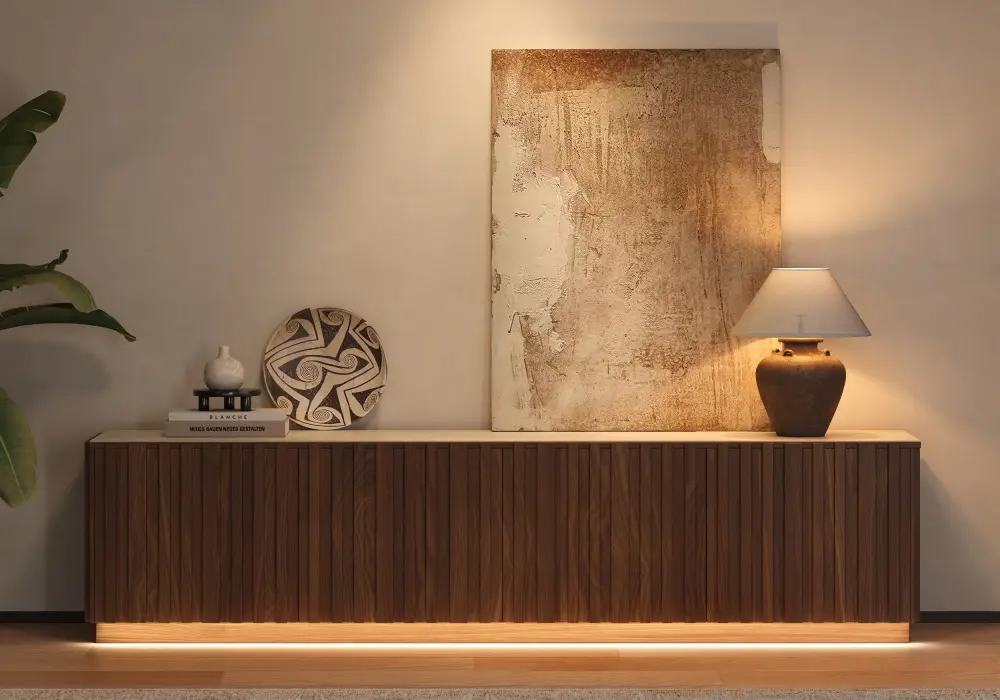
Ash Wood Fluted Walnut TV Stand of Homary
Backlighting for Atmosphere
A soft LED strip behind the TV can create a gentle glow around the screen. For a subtle effect, position the light so it washes the wall rather than shining directly into the room.
Keeping the light source close to the back edge of the TV or stand usually creates a cleaner halo effect than placing a bright strip too far out from the screen.
Warm or neutral white lighting tends to feel more relaxing in a living room than extremely cool lighting.
Table Lamps for Decorative Depth
A lamp on the TV stand can add both function and visual height. Place it toward one side of the stand and balance it with another object on the opposite side.
A lamp with a soft shade can also make the room feel more inviting when the main ceiling lights are turned off.
Track and Accent Lighting
Directional lighting can highlight artwork, shelving, or architectural details around the TV. Just make sure the beam is not aimed directly at the screen.
Glare can also come from windows and overhead lights. If your TV faces a bright window, consider curtains or blinds that can reduce direct daylight during viewing hours.
A useful decorating principle is simple: light the wall and the objects around the TV, not the screen itself.
Quick TV Wall Upgrade Checklist
Simple Upgrade | More Noticeable Upgrade |
Hide visible cables | Add wall-mounted or custom shelving |
Add one plant | Install layered accent lighting |
Rearrange existing accessories | Replace mismatched decor with a coordinated set |
Add a small lamp | Create a larger artwork or gallery arrangement |
The goal is not to make the TV disappear. It is to make the TV feel like a natural part of the room.
Turn Your TV Wall Into a Finished Design Feature
Decorating around a TV stand is really about balance. Start by planning the layout, then use proportion to connect the TV, furniture, artwork, and accessories. Layer objects from tall to low, repeat colors and materials throughout the room, and leave enough negative space to keep everything visually calm.
Once the foundation is right, small details such as hidden cables and soft accent lighting can make a surprisingly big difference.
Ready to make your TV wall look more polished? Use a printable TV wall layout template to map out your artwork, TV stand, and decor before you start moving furniture. You can also create a budget-based shopping list so you know exactly which pieces to buy first.
In just five minutes, you can turn a blank TV wall into a personalized decorating plan that fits your space, style, and budget.
FAQ
What's the ideal height and spacing for wall art next to a TV?
There is no single perfect measurement because it depends on the size of the TV and the wall. As a starting point, leave around 4–12 inches between the TV and nearby artwork, then adjust according to scale. Artwork should feel connected to the TV without touching or crowding it.
How do I style a TV stand so it doesn't look cluttered?
Use fewer, larger items instead of many tiny accessories. Start with one tall object, add one or two medium pieces, and finish with a low decorative element. Leave some empty surface area so the arrangement can breathe.
What are simple ways to hide TV cables without drilling into walls?
Adhesive cable clips, cable sleeves, cord covers, and cable-management boxes are simple options. For a wall-mounted TV, a paintable raceway can visually blend into the wall while hiding the cables.
How can I decorate a small TV stand in a studio or apartment?
Choose slim furniture, multifunctional storage, and lightweight decorative pieces. A small lamp, one plant, a few books, and a decorative basket may be enough. Avoid filling every shelf or surface.
What lighting works best to reduce TV glare while adding ambiance?
Use soft lighting behind the TV, a dim table lamp, or directional accent lighting aimed at the wall or decor rather than the screen. Curtains or blinds can also help reduce reflections from windows.
How do I refresh my TV stand decor for each season on a budget?
Keep your main arrangement and rotate just a few accent pieces. Swap plants, textiles, vases, books, and seasonal objects instead of buying a completely new collection. This keeps the look fresh without creating unnecessary clutter.