

Coffee tables commonly sit around 16–18 inches high, but the right height depends on your sofa, your seated reach, and how you use the table. Treat this range as a starting point rather than a universal rule.
When comparing coffee tables, compare the tabletop with your sofa’s seat cushions and consider how comfortably you can reach it from your usual sitting position.
Table of Contents
Understand What an Average Would Actually Describe
A true market average requires a defined collection of products and a stated calculation. A common design guideline is different from a measured market average, and neither automatically identifies the height that will suit your sofa or room.
Several external references support the 16–18-inch range as a useful starting point. Bob Vila’s coffee table height guide recommends a height of 16–18 inches, generally paired with a sofa seat measuring 17–19 inches. HGTV’s furniture design guidance gives the same typical range and recommends accounting for the sofa seat height.
For a measured product sample, Alcovio’s coffee table dimensions guide reports measurements from 188 coffee tables in its catalog. The median height was 17 inches, and the middle half measured 16–18.5 inches. This is a useful catalog-based reference, not a representative survey of the entire coffee table market.
The conventional 16–18-inch range helps narrow your initial search. A table listed at 15 inches may feel noticeably low beside upright seating, while an 18-inch model may work better with a higher sofa seat. The comparison becomes meaningful when you consider your actual seating height and reach.
Keep overall height separate from leg clearance and tabletop thickness. Overall height normally describes the assembled measurement from the floor to the top surface. Use the dimension drawing to compare the same measurement across products.
Measure Your Sofa Before Selecting the Table
Measure from the floor to the top of the seat cushion where you normally sit. Then sit down and notice how much the cushion compresses. Your ordinary seated position provides practical context for choosing a reachable tabletop height.
As a design starting point, test a tabletop close to the seat height or slightly lower. Place a stable temporary surface at the proposed height and try it without changing your posture. If you need to perch on the cushion edge to reach it, the height, distance, or both may need adjusting.
Repeat the test from the seats used most often. A table centered in front of a long sofa may be convenient for one person and far away for someone at the end. A sectional adds a corner and chaise to the problem. A supplementary side table can sometimes serve those positions more effectively than enlarging the central table.
Compare Three Coffee Tables by Height and Function
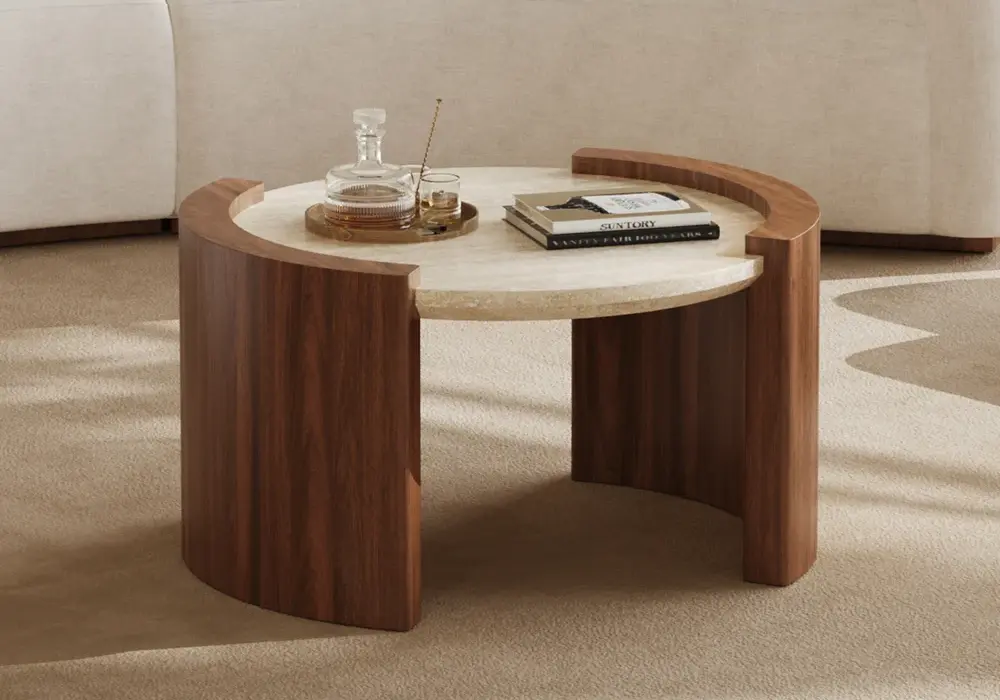
The 28-inch walnut round coffee table with a travertine top has a listed overall height of 15 inches and an approximate footprint of 28 by 25 inches. Its low profile and rounded shape make it a suitable option for relaxed seating arrangements and compact living areas. The 15-inch height is particularly relevant when comparing tables for a low-profile sofa.
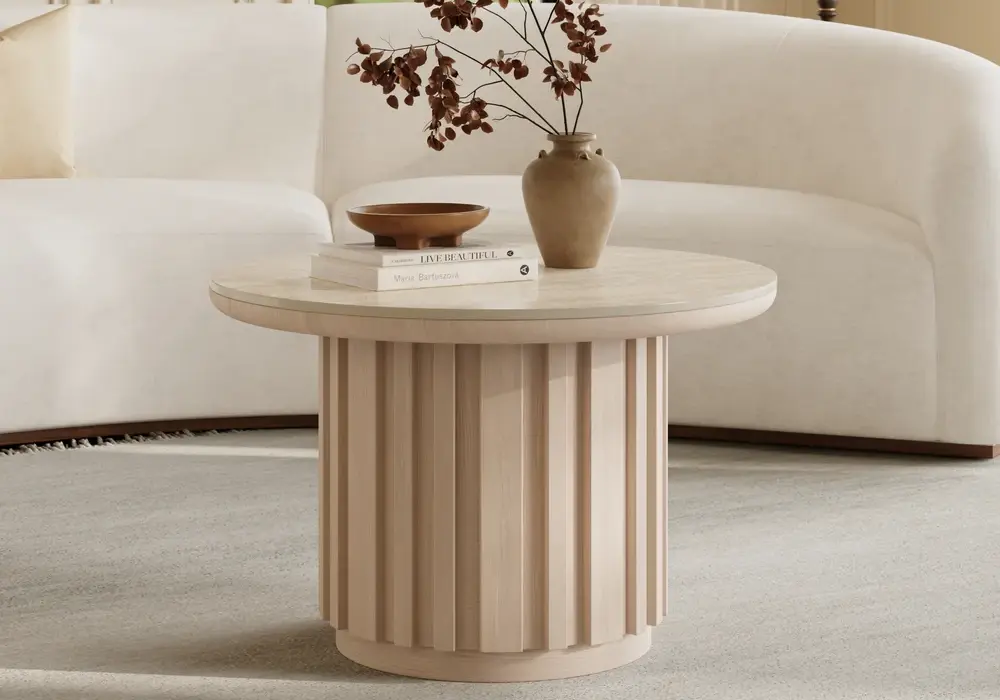
The Aura Ash Wood Slatted Round Coffee Table with Sintered Stone Top has a standard overall height of 18 inches. Its round sintered stone top and sculptural slatted ash wood base make it a striking centerpiece for a living room with higher seating. Its 18-inch height pairs well with sofas with higher seat cushions.
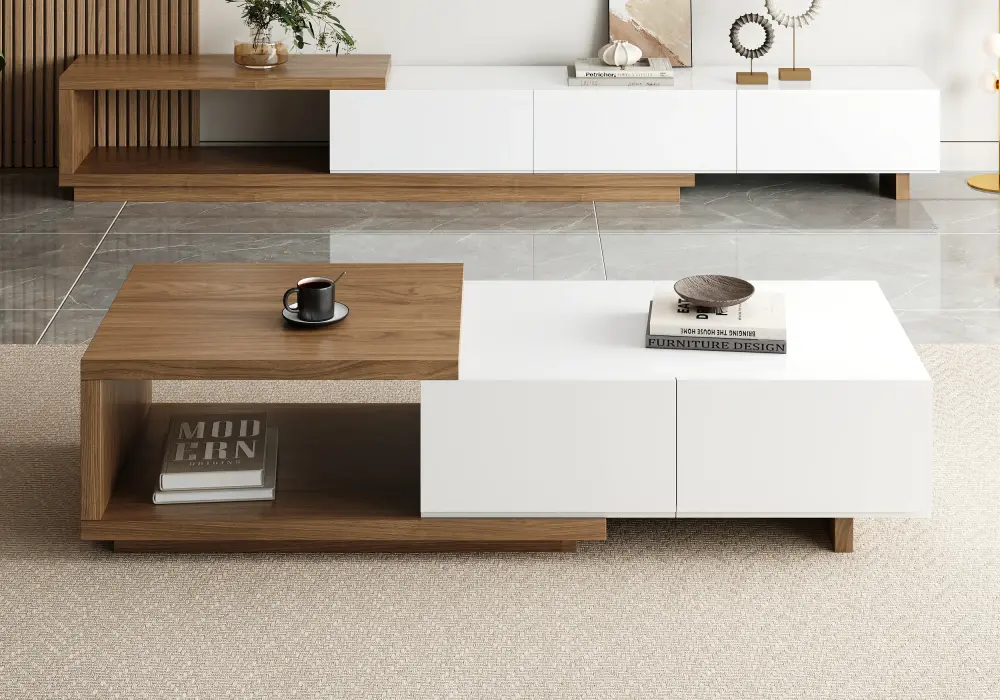
The Quoint 47–69-inch extendable coffee table in the walnut option is listed at 16 inches high. Its extendable surface and two drawers make it a practical choice for living rooms that need flexible tabletop space and concealed storage. At 16 inches high, it offers a low profile with an extendable surface for added space when needed.
Coffee table example | Listed overall height | Primary use |
Compact walnut table with travertine top | 15 inches | Low seating and a compact footprint |
Aura round table with sintered stone top | 18 inches | A sculptural centerpiece for higher seating |
Walnut Quoint extendable table | 16 inches | Flexible tabletop length and drawer storage |
These examples illustrate how height, shape, and function differ across individual products. Use the listed dimensions to compare each design with your sofa and everyday needs.
Include Horizontal Reach in the Height Test
A table that feels too low may also be too far away. Move a temporary surface within the usable seating area and test both dimensions together. Preserve the route people need to enter and leave the sofa without creating a tight gap just to improve reach.
As a layout experiment, start with a gap around 14–18 inches and adjust for your seating and household. This is a practical furniture-placement guideline, not an accessibility standard or a clearance requirement for a reclining mechanism. Where mobility needs are involved, assess the complete route and furniture arrangement individually.
Try the actual activity with lightweight objects. Set down an empty cup, pick up a book, and stand beside the mock-up. Testing from a normal sitting position reveals whether the proposed table requires an awkward repeated reach.
Distinguish Extension from a Lift-Top Function
An extendable coffee table changes its footprint; it does not necessarily raise the surface. If a listing gives a length range, do not interpret that as adjustable height. Read the mechanism description and dimension drawing to establish which parts move and in which direction.
A lift-top table needs separate closed and raised measurements. Its raised position may bring a surface closer for an occasional task, but it should also provide adequate knee room, reach, and stability. One table’s raised height does not establish another model’s range of movement.
For any moving design, plan the space needed to operate it and keep hands clear as instructed. Check the load limits for the relevant position and clear the surface before moving it where required. A storage compartment or adjustable top should never be assumed to support a person.
Check the Whole Room Before Settling on a Number
Height is only one dimension of fit. Mark the tabletop and base on the floor, then open nearby drawers and walk the usual routes. A table that works well from the sofa can still block a doorway, interfere with a media cabinet, or make the seating corner difficult to enter.
If your sofa reclines, account for its full operating range when placing the table. For a sleeper sofa, plan where the table will go while the bed is open. A conventional coffee-table gap does not guarantee adequate room for either mechanism, and frequent moving may be impractical for a heavy piece.
Review the delivery route, assembly requirements, and care instructions as part of the purchase. A low profile does not mean a table is light or easy to carry. Confirm the dimensions of the delivered components, particularly when the tabletop uses stone or another substantial material.
Frequently Asked Questions
Is 17 inches the average coffee table height?
Seventeen inches is the midpoint of the common 16–18-inch guideline. It is also the median reported in Alcovio’s sample of 188 coffee tables, where the middle half measured 16–18.5 inches. That result describes the measured catalog sample, not every coffee table on the market. Your sofa cushion height, seated posture, and horizontal reach should guide the final choice.
Can a 15-inch coffee table work with a regular sofa?
Yes. A 15-inch table can work well with lower seating or a sofa whose cushion height makes the surface comfortable to reach. Test it at the intended distance from your normal sitting position. If you need to lean down repeatedly to reach it, compare a taller option.
Do two tables with the same height feel the same to use?
Not necessarily. Depth, edge position, base design, and storage openings can change reach and movement around the table. Compare the complete footprint and position beside the sofa, not just the overall height.
Does extending a coffee table make it higher?
Only if the design includes a separate height-changing function. A length range normally describes the horizontal footprint. Confirm the mechanism and dimension drawing for the exact model, and use separate closed and raised measurements for a lift-top table.
How should I compare online height measurements?
Compare overall assembled height, then check which surface and configuration the dimension drawing measures. Keep leg clearance, tabletop thickness, and raised positions separate. Match the listed height to your sofa seat measurement and intended use before choosing a table.